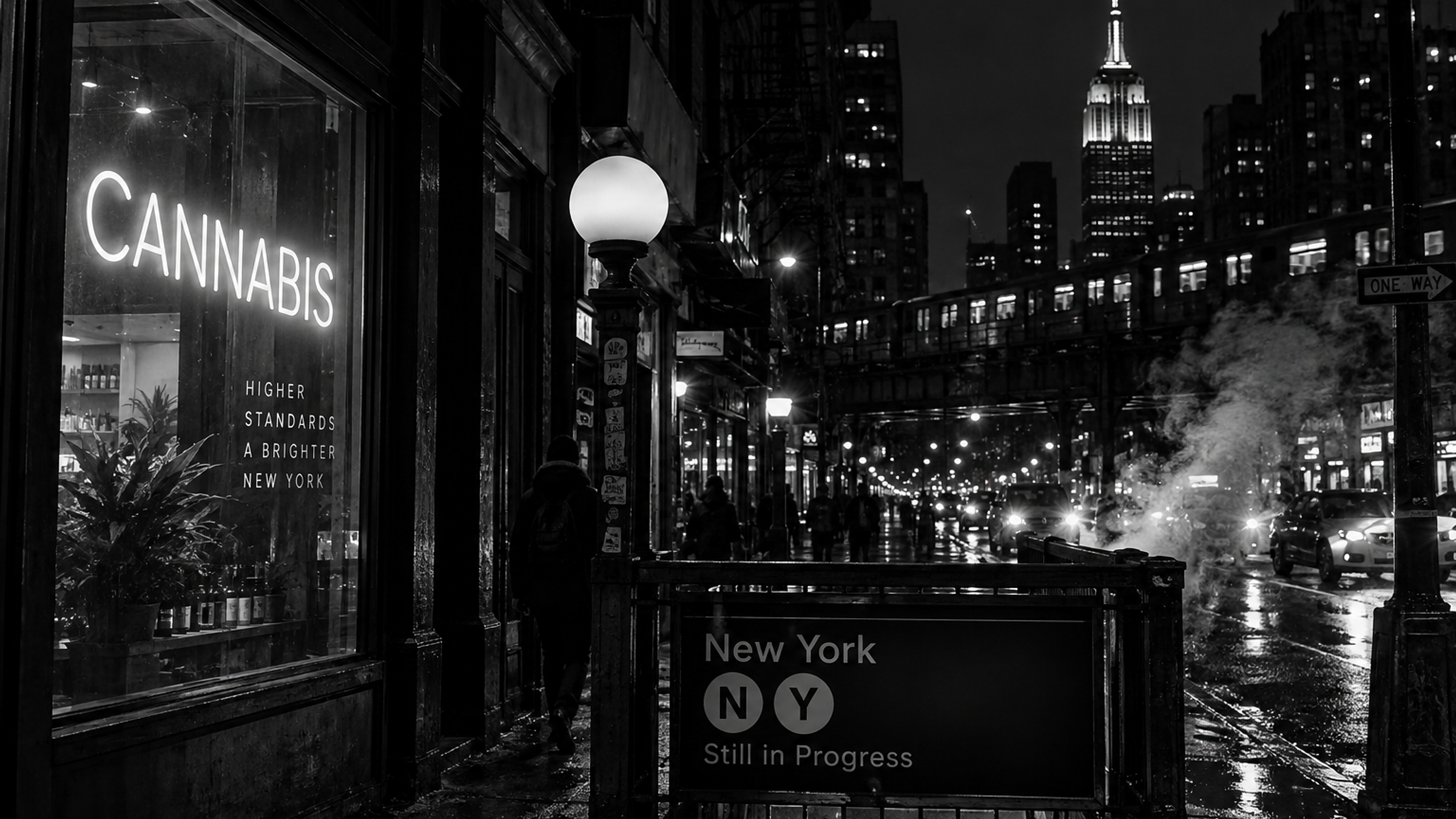
NEW YORK IS STILL FINDING ITS CANNABIS IDENTITY
Legal cannabis is here. The culture was already here. What happens when growers, brands, dispensaries and legacy knowledge begin shaping something distinctly New York?
New York did not discover cannabis when the first licensed dispensary opened its doors.
The plant was already here.
The growers were here.
The customers were here.
The language, rituals, genetics, music, informal markets and communities surrounding cannabis had been developing for decades before legalization gave the industry a new set of rules.
What legalization introduced was not cannabis.
It introduced a framework.
And now New York has to decide what it wants to build inside it.
New York Has Always Had Cannabis
It is easy to talk about a legal cannabis market as though an industry suddenly appeared when regulators issued licenses.
That misses the history.
New York already had a cannabis economy long before licensed retail.
Flower moved through neighborhoods, music scenes and social networks. Consumers developed preferences. Certain growers and sources built reputations. Genetics traveled across state lines. California became synonymous with premium cannabis for many East Coast consumers.
There was already a culture determining what people considered desirable.
Regulation did not erase that history.
It placed a new system around it.
That distinction matters because the identity of New York cannabis will not be created exclusively by regulations, investors or packaging.
It will also be shaped by what existed before them.
The California Shadow
For years, California has been one of the dominant reference points for premium American cannabis.
The genetics.
The breeders.
The brands.
The bags.
The strain names.
The visual language.
Even the idea of "exotic" flower became closely associated with products moving east from established West Coast cannabis markets.
California earned much of that influence through decades of cultivation, breeding and cannabis culture.
But influence can eventually become imitation.
If every emerging market defines premium cannabis according to what California already established, regional identity becomes difficult to develop.
New York can grow California genetics.
It can sell brands consumers already recognize.
It can borrow ideas that work elsewhere.
But eventually the question becomes:
What makes cannabis from New York interesting because it is from New York?
That answer is still developing.
The People Growing Here
Genetics establish possibilities.
Growers create expressions.
Two cultivators can work with related genetics and produce noticeably different flower because cultivation is not simply replication.
Environment matters.
Selection matters.
Plant health matters.
Harvest timing matters.
Drying matters.
Curing matters.
Storage matters.
Experience matters.
As New York cultivators become better known, consumers have an opportunity to move beyond shopping entirely by strain name.
Instead of only asking:
What strain is it?
We can start asking:
Who grew it?
That is a meaningful shift.
Wine consumers learn vineyards.
Coffee drinkers learn roasters and origins.
People who care about food learn farms, chefs and producers.
Cannabis can develop the same kind of literacy.
A cultivar may get someone interested.
A cultivator can become the reason they come back.
The Dispensary Is More Than a Shelf
Retailers also play a role in defining the market.
A dispensary decides what products receive shelf space.
Staff members influence what customers discover.
Menus determine visibility.
Recommendations influence purchasing.
Education changes how people evaluate quality.
That means retail is not neutral.
Every purchasing decision helps determine which cultivators, processors and brands are given an opportunity to build an audience.
That carries responsibility.
A market dominated entirely by recognizable packaging and potency percentages will develop differently from one where retailers also introduce customers to local growers, unusual genetics, thoughtful processing and products with a story behind them.
A dispensary can simply sell cannabis.
Or it can help people understand what they are buying.
Those produce very different cultures.
What Does New York Premium Mean?
This may be one of the most interesting unanswered questions in the market.
What exactly should qualify as premium New York cannabis?
Is it high THC?
Rare genetics?
Indoor cultivation?
Strong terpene expression?
A meticulous cure?
Local provenance?
Craft-scale production?
Beautiful flower?
Brand reputation?
Scarcity?
There is no governing body that can answer that question for the culture.
And there probably shouldn't be.
Markets develop their own standards through experience.
Consumers learn.
Growers improve.
Retailers become more selective.
Brands rise and disappear.
Some products live up to their presentation.
Others don't.
Over time, reputation becomes harder to manufacture.
That process is happening now.
Legacy Knowledge Doesn't Disappear
Legalization can create the impression that expertise begins with licensure.
It doesn't.
Some of the people who understand cannabis most deeply learned outside the regulated market.
They grew before licenses existed.
They selected genetics before legal brands could trademark names.
They learned cultivation through repetition, failure and informal knowledge networks.
They developed relationships with consumers long before dispensaries had loyalty programs.
New York's regulated market has the opportunity to absorb some of that knowledge.
It also has the ability to lose it.
The more effectively experienced operators can move into legitimate cultivation, retail, processing, education and entrepreneurship, the more continuity the industry retains.
A legal market does not have to erase the culture that preceded it.
It can document it.
Learn from it.
And build something better around it.
New York Doesn't Need to Become California
That isn't criticism of California.
It is an argument for regional identity.
New York has its own cities.
Its own agricultural regions.
Its own immigrant communities.
Its own music.
Its own neighborhoods.
Its own legacy cannabis history.
Its own growers.
Its own consumers.
Its own problems.
Those differences should eventually produce a cannabis culture that feels different too.
Maybe that identity comes from cultivators.
Maybe it comes from retail.
Maybe it emerges through genetics, events, hash culture, media, design or something nobody has named yet.
Most likely, it comes from all of them.
The interesting part is that the answer has not been settled.
Still in Progress
New York cannabis does not need another publication telling it what it is supposed to become.
It needs people paying attention while it becomes something.
The growers.
The stores.
The genetics.
The products.
The mistakes.
The breakthroughs.
The people who were here before legalization.
The people entering now.
And the consumers gradually deciding what deserves their attention.
That is the story worth documenting.
New York is still finding its cannabis identity.
Good.
We're early enough to watch it happen.
FROM THE FIELD / BUFFALO
New York cannabis identity isn't developing in one place. House of Za operates in Buffalo's University District, providing a ground-level view of how consumers, products, brands and local cannabis culture are evolving.
VISIT HOUSE OF ZAHouse of Za is a founding retail collaborator of The Za Report. The Za Report is independently owned and operated. Commercial relationships do not determine editorial coverage or opinions.