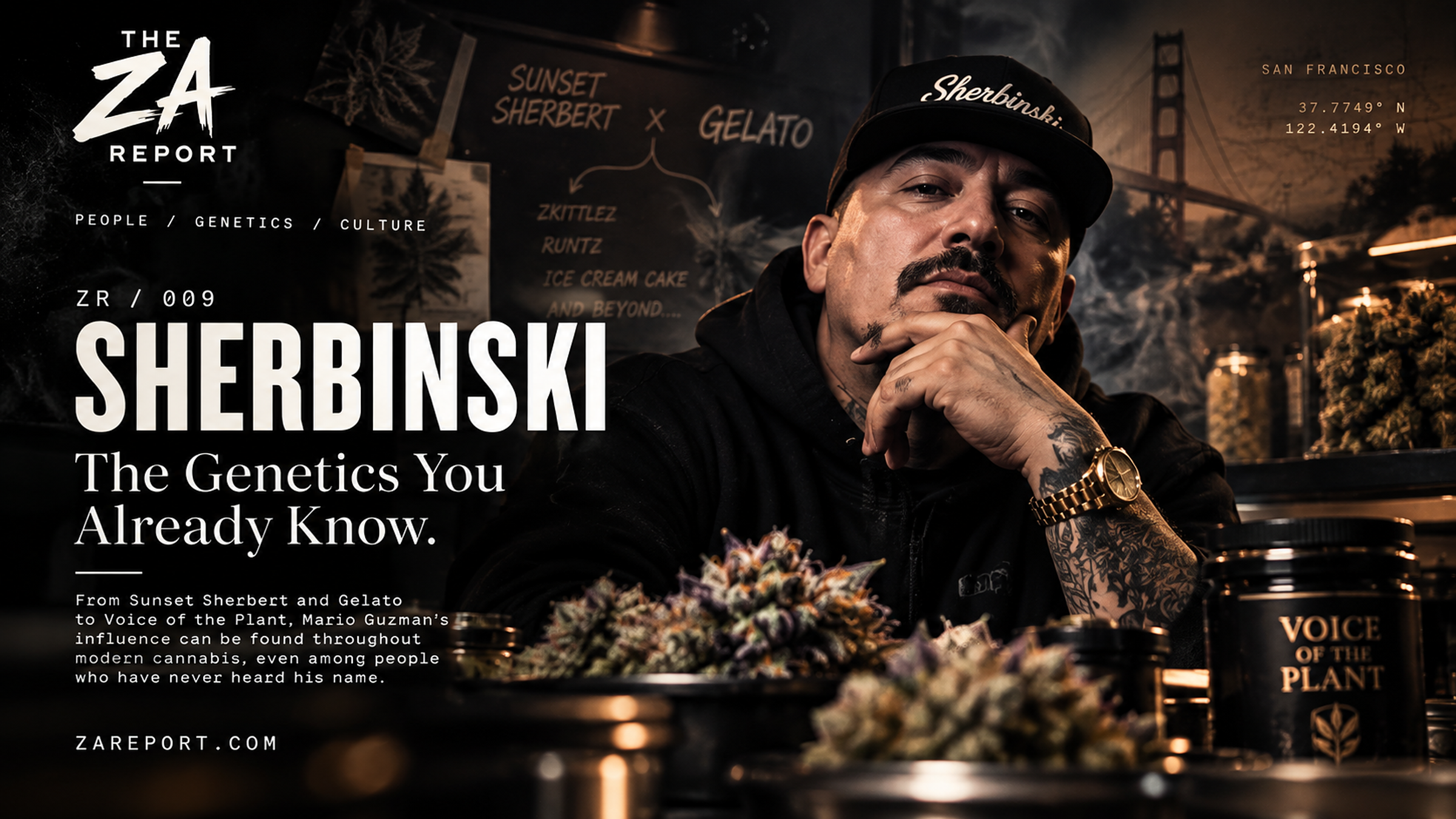
SHERBINSKI: THE GENETICS YOU ALREADY KNOW
From Sunset Sherbert and Gelato to Voice of the Plant, Mario Guzman's influence runs through modern cannabis genetics, culture and the countless cultivars that followed.
You may not know Mario Guzman.
But you probably know his work.
Sunset Sherbert.
Gelato.
Bacio. Mochi. Acai Berry.
Names that moved from grow rooms into dispensary menus, breeding projects, music, fashion and eventually the vocabulary of modern cannabis.
Today, Gelato genetics are so widespread that it can be easy to forget there was a person, a place and a series of selections behind them.
That person is Mario Guzman.
Most of the cannabis world knows him by another name:
Sherbinski.
THE GENETICS YOU ALREADY KNOW
Cannabis genetics rarely stay in one place.
A cultivar gets selected. Someone receives a cut. Another grower works with it. A breeder makes a cross. That cross becomes the parent of another cross.
Eventually, the genetic family becomes larger than the original plant.
Few modern examples illustrate that better than Gelato.
Gelato is associated with the pairing of Sunset Sherbert and Thin Mint Cookies. From that family came selections including Bacio Gelato #41, Mochi and Acai Berry Gelato.
Those names became products.
Then references.
Then ingredients in entirely new genetic lines.
Walk through enough dispensary menus and you'll eventually encounter something connected to Gelato, Sherbert, Cookies or one of the families that grew around them.
The influence is hiding in plain sight.
BEFORE GELATO, THERE WAS SHERBERT
The story begins in San Francisco.
Guzman has described cultivating cannabis in small indoor grows during California's medical cannabis era, including a grow in his grandmother's garage.
One mistake became particularly important.
According to Guzman's account, he introduced a Pink Panties plant into a room containing Cookies plants before he understood how to properly identify its sex.
The plant was male.
The room was pollinated.
What initially looked like a ruined crop produced thousands of seeds.
Guzman kept some of them.
From those seeds, he selected what became Sunset Sherbert.
Even the name carried geography and memory.
"Sunset" referenced San Francisco's Sunset District.
"Sherbert" came from the flavor profile Guzman associated with the Rainbow Sherbet ice cream he remembered from childhood.
The cultivar wasn't simply given a catchy name after the fact.
The name documented where it came from and what its creator experienced in it.
SELECTION CHANGES EVERYTHING
Breeding creates possibilities.
Selection decides which possibilities continue.
That's one of the details that gets lost when cannabis genetics are reduced to a family tree printed on a package.
Seeds from the same cross are not necessarily identical.
Growers germinate populations, observe differences and decide which individual plants deserve to continue.
Those decisions can involve aroma, structure, vigor, appearance, resin production and countless other characteristics.
Guzman's story is filled with those decisions.
Sunset Sherbert became part of the next one.
Crossed with Thin Mint Cookies, it produced the family that became known as Gelato.
Different selections emerged from that population.
Some became famous in their own right.
And eventually, Gelato stopped being simply the name of a genetic project.
It became part of cannabis culture.
WHEN GENETICS BECOME CULTURE
There is a point where a cultivar becomes bigger than the grow room that produced it.
Gelato crossed that line.
The name appeared in music.
It appeared in fashion.
It appeared on menus across legal and legacy cannabis markets.
Growers crossed Gelato selections into new genetics.
Brands built products around the name.
Consumers began asking for it.
That kind of influence creates an unusual situation.
The more successful a genetic becomes, the harder its history can be to see.
Thousands of people can encounter descendants, crosses and products carrying pieces of the lineage without knowing anything about the person who helped select the plants that started it.
That's why cannabis history can't only be a history of strain names.
It has to be a history of people.
THE PERSON AND THE BRAND
Sherbinski eventually became more than Guzman's nickname.
It became a commercial identity.
The Sherbinskis brand expanded beyond flower into retail, manufactured products, collaborations and licensing.
For years, the person and the brand could appear inseparable from the outside.
Today, that relationship is more complicated.
Guzman has publicly described a separation from the business currently operating under the Sherbinskis name and has made claims concerning ownership, compensation, use of his identity and control of genetics associated with his work.
Those claims are disputed and should not be treated as established legal findings.
The distinction matters for another reason.
A cannabis brand can change ownership.
A trademark can be transferred.
A company can continue operating.
But cultural authorship, genetic provenance and commercial ownership are not necessarily the same thing.
Who owns a brand?
Who created a cultivar?
Who possesses the original plant material?
Who is authorized to reproduce it?
Who gets remembered?
Cannabis legalization is forcing an industry built partly through informal relationships, shared cuts and underground networks to confront questions that conventional businesses have spent generations documenting through contracts and intellectual property law.
Sherbinski's story now sits directly inside that conversation.
WHO OWNS A STRAIN?
For decades, cannabis genetics moved differently from most commercial intellectual property.
Plants were passed between growers.
Cuts were traded.
Seeds traveled.
Names changed.
Lineage information sometimes survived through community knowledge rather than formal documentation.
Legalization changed the economic value of that history.
A famous genetic can now support flower releases, concentrates, vape products, licensing agreements, international expansion and entirely new brands.
That makes provenance more than trivia.
It can become an asset.
Guzman has increasingly emphasized preservation, authenticity and breeder recognition when discussing the genetics associated with his work.
The questions surrounding those genetics aren't unique to him.
They point toward a much larger issue for cannabis:
As the industry grows, how does it remember and protect the people who created what everyone else is selling?
VOICE OF THE PLANT
Guzman's current chapter is Voice of the Plant, which he co-founded with Victorine Deych.
The project broadens the conversation beyond a single famous cultivar.
Deych brings a background in natural perfumery and sensory work, while Guzman brings decades of cultivation, selection and genetic history.
Together, they have described Voice of the Plant as a platform connecting genetics with aroma, education, art, food, music and community.
That framing feels appropriate for someone whose most recognizable work escaped the boundaries of cultivation years ago.
Because Gelato didn't remain a plant.
It became language.
It became flavor.
It became branding.
It became music.
It became a parent to other genetics.
It became something people recognized before they necessarily knew where it came from.
FROM SAN FRANCISCO TO NEW YORK
Now the story has reached New York.
Guzman and Deych have spoken publicly about bringing Voice of the Plant genetics into the state's developing cannabis market.
That makes this history especially relevant here.
New York is still young enough as a legal adult-use market that consumers are learning which cultivators, brands and genetics they want to follow.
At the same time, many of the genetics arriving on New York shelves carry histories that began somewhere else.
California.
The Bay Area.
A garage.
A grower making selections from a tray of seeds.
Understanding those histories gives consumers another way to look at cannabis.
Not simply:
What's the THC?
But:
Who grew this?
Who bred it?
Where did the genetics come from?
What happened before this package reached the shelf?
REMEMBER THE PEOPLE
Cannabis loves names.
Strain names.
Brand names.
Product names.
But those names can obscure the people behind them.
Mario Guzman's story is a reminder that some of the most recognizable things in cannabis began with individuals working long before there was a legal national industry waiting to monetize their ideas.
Sunset Sherbert started with seeds from an unexpected pollination.
Gelato grew from the genetics that followed.
Those plants traveled.
The names traveled farther.
And eventually the influence became so widespread that millions of people could recognize the genetics without recognizing the person.
That's exactly why the people matter.
Because cannabis history isn't only stored in archives.
Sometimes it's stored in the plants themselves.
And sometimes you've known someone's work for years before you ever learned their name.
FROM THE STORY TO THE SHELF / HOUSE OF ZA
The genetics and ideas documented in this story continue into New York through Voice of the Plant. House of Za, a founding retail collaborator of The Za Report, currently carries select Voice of the Plant products in Buffalo.
EXPLORE HOUSE OF ZAHouse of Za is a founding retail collaborator of The Za Report. The Za Report is independently owned and operated. Commercial relationships do not determine editorial coverage or opinions.