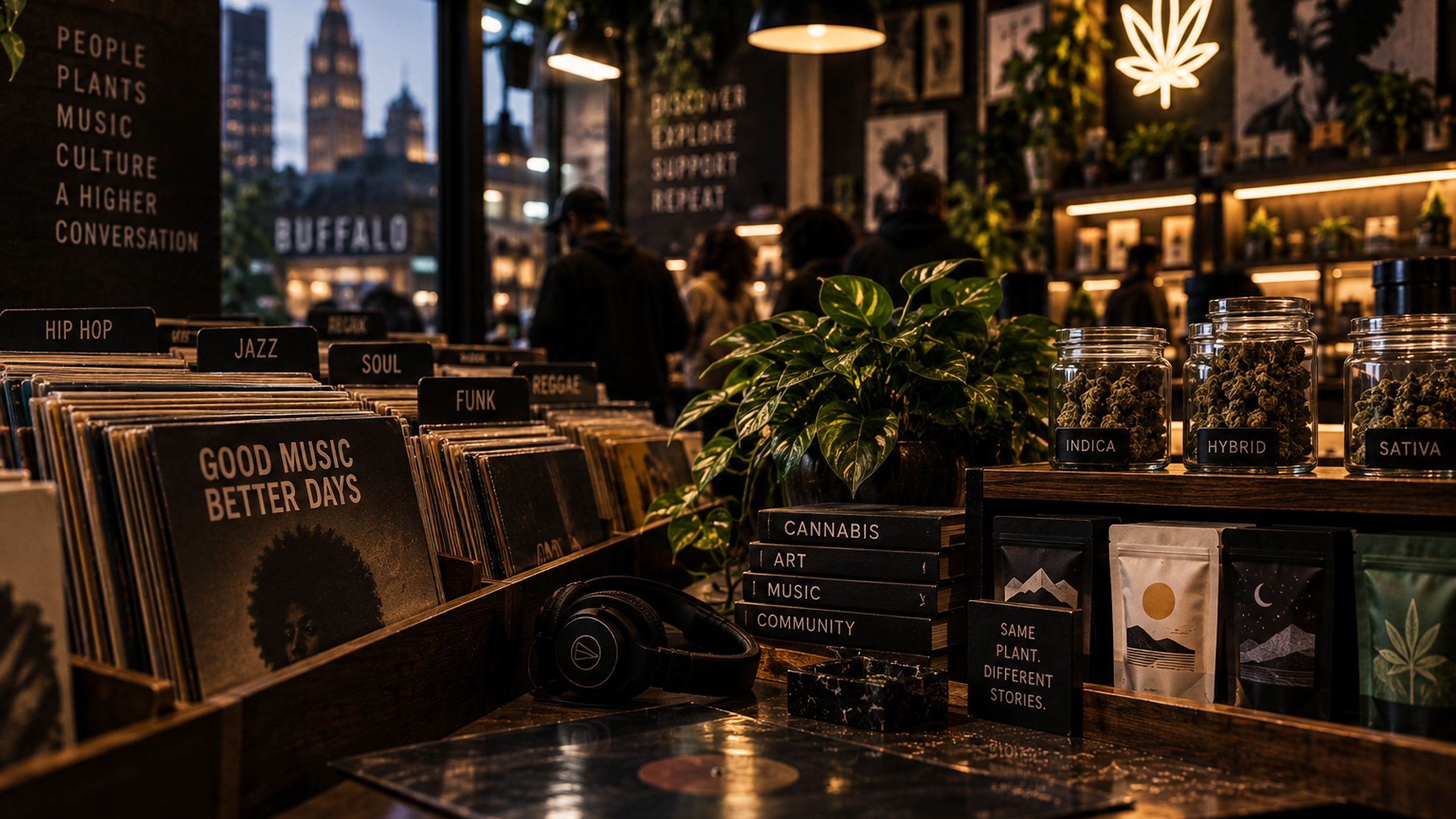
THE DISPENSARY IS BECOMING THE NEW RECORD STORE
Before algorithms told us what to like, discovery happened through people, places and taste. Cannabis retail has an opportunity to bring that experience back.
There was a time when discovering something new meant going somewhere.
You walked into a record store knowing what you liked, but not necessarily knowing what you were leaving with.
Maybe you came looking for hip-hop and walked out with a soul record someone behind the counter insisted you needed to hear.
Maybe an album cover caught your attention.
Maybe something playing over the speakers made you stop and ask a question.
Discovery happened through people, places and taste.
Cannabis retail has an opportunity to bring some of that experience back.
Before the Algorithm
Today, discovery is increasingly predictive.
Streaming platforms know what you've listened to. Online stores know what you've bought. Social platforms learn what keeps you looking at the screen.
Convenience improved.
Something else became harder to find.
Surprise.
The old record store wasn't simply inventory arranged alphabetically. The best stores had personalities.
The records on the wall mattered.
The music playing mattered.
The person behind the counter mattered.
You learned which employee understood your taste. You learned which section had the strange imports. You learned which store would put you onto something before everyone else knew about it.
The store developed a point of view.
Cannabis Has the Same Opportunity
Walk into a legal dispensary today and the amount of information can be overwhelming.
Brands.
Strain names.
THC percentages.
Terpenes.
Flower.
Vapes.
Concentrates.
Edibles.
Pre-rolls.
New products arrive constantly.
For someone already immersed in cannabis, that can be exciting.
For everyone else, it can look like a wall of choices.
That's where retail becomes more than shelves.
A good dispensary helps people navigate.
A great one helps people discover.
The Budtender Is the Person Behind the Record Counter
The comparison becomes clearest at the counter.
A knowledgeable record-store employee didn't simply ask what album had the highest sales number.
They asked what you listened to.
What you already owned.
What mood you were after.
Then they made connections.
Cannabis can work the same way.
A knowledgeable budtender can move the conversation beyond a single THC number or whatever product happens to be trending online.
What have you enjoyed before?
What aromas do you tend to notice?
Are there cultivators you've liked?
Are you curious about something completely different?
The value isn't knowing which package has the biggest number printed on it.
The value is developing taste.
Curation Is a Point of View
Most retailers can't carry everything.
That isn't necessarily a weakness.
It can be an identity.
Record stores became destinations because somebody made decisions about what belonged in the building.
Cannabis retailers make those decisions too.
Which cultivators get shelf space?
Which new brands get introduced?
Which products get reordered?
Which local producers get a chance?
Which products does the staff actually understand well enough to discuss?
Over time, those decisions tell customers what the store values.
That's curation.
And curation can become part of the brand.
The Package Is the Album Cover
Cannabis also happens to be an unusually visual industry.
Packaging carries typography, illustration, photography, color, characters and entire fictional worlds.
Some brands are minimal.
Some are loud.
Some reference fashion.
Some reference street culture.
Some feel agricultural.
Some feel pharmaceutical.
Some look like luxury goods.
Before someone ever opens the package, design has already communicated something.
Record covers did the same thing.
Sometimes you discovered the music because the artwork made you pick up the record.
Cannabis packaging can start that conversation too.
But just like an album cover, the package isn't the product itself.
Eventually, what's inside has to deliver.
Local Stores Create Local Scenes
Independent record stores were also gathering points.
Flyers appeared near the register.
Local artists left music there.
People learned about shows.
Scenes developed around physical places.
Cannabis retailers have the potential to occupy a similar position in legal cannabis culture.
Not simply as places where transactions occur, but as places where consumers encounter local cultivators, artists, educators, events and ideas.
That matters particularly in a market like New York, where the identity of legal cannabis is still being formed.
California already has decades of recognizable cannabis mythology.
New York is building its own.
Retailers will help determine what that looks like.
Taste Can Be a Competitive Advantage
Price matters.
Selection matters.
Convenience matters.
Those things will always matter in retail.
But they're also relatively easy for competitors to imitate.
Taste is harder.
A store develops taste through hundreds of small decisions.
What it carries.
What it recommends.
What it teaches.
What it celebrates.
Who it collaborates with.
What music is playing.
What happens inside the space when nobody is trying to sell anything.
Eventually customers aren't only returning because a product is available.
They're returning because they trust the filter.
The Store Becomes the Interface
The internet trained us to think of interfaces as screens.
But a good physical store is an interface too.
The shelves are navigation.
The staff are search.
Displays are recommendations.
Events are discovery.
Conversation is personalization.
And the inventory is the library.
Cannabis retail becomes more interesting when we stop thinking of the dispensary as the final step in a supply chain and start thinking about it as the place where everything upstream becomes understandable to a person.
The cultivator.
The genetics.
The processor.
The brand.
The packaging.
The story.
The culture.
They all meet at the shelf.
Bring Back Discovery
Maybe the dispensary doesn't literally become the new record store.
It doesn't need to.
But the best cannabis retailers can borrow something important from the places where culture used to be discovered in person.
Have a point of view.
Know what's on the shelf.
Know who made it.
Introduce people to something they wouldn't have found themselves.
Give local culture somewhere physical to exist.
And make the experience worth leaving the algorithm for.
Because sometimes you shouldn't know exactly what you're looking for before you walk through the door.
Sometimes the point is discovering it.
This is The Za Report.
Cannabis. Culture. People.
The story behind the Za.
CULTURE CONNECTION / HOUSE OF ZA
Cannabis retail can be more than a transaction. House of Za is a licensed Buffalo dispensary and founding retail collaborator of The Za Report, creating a physical space where products, people, education and local cannabis culture can meet.
EXPLORE HOUSE OF ZAHouse of Za is a founding retail collaborator of The Za Report. The Za Report is independently owned and operated. Commercial relationships do not determine editorial coverage or opinions.