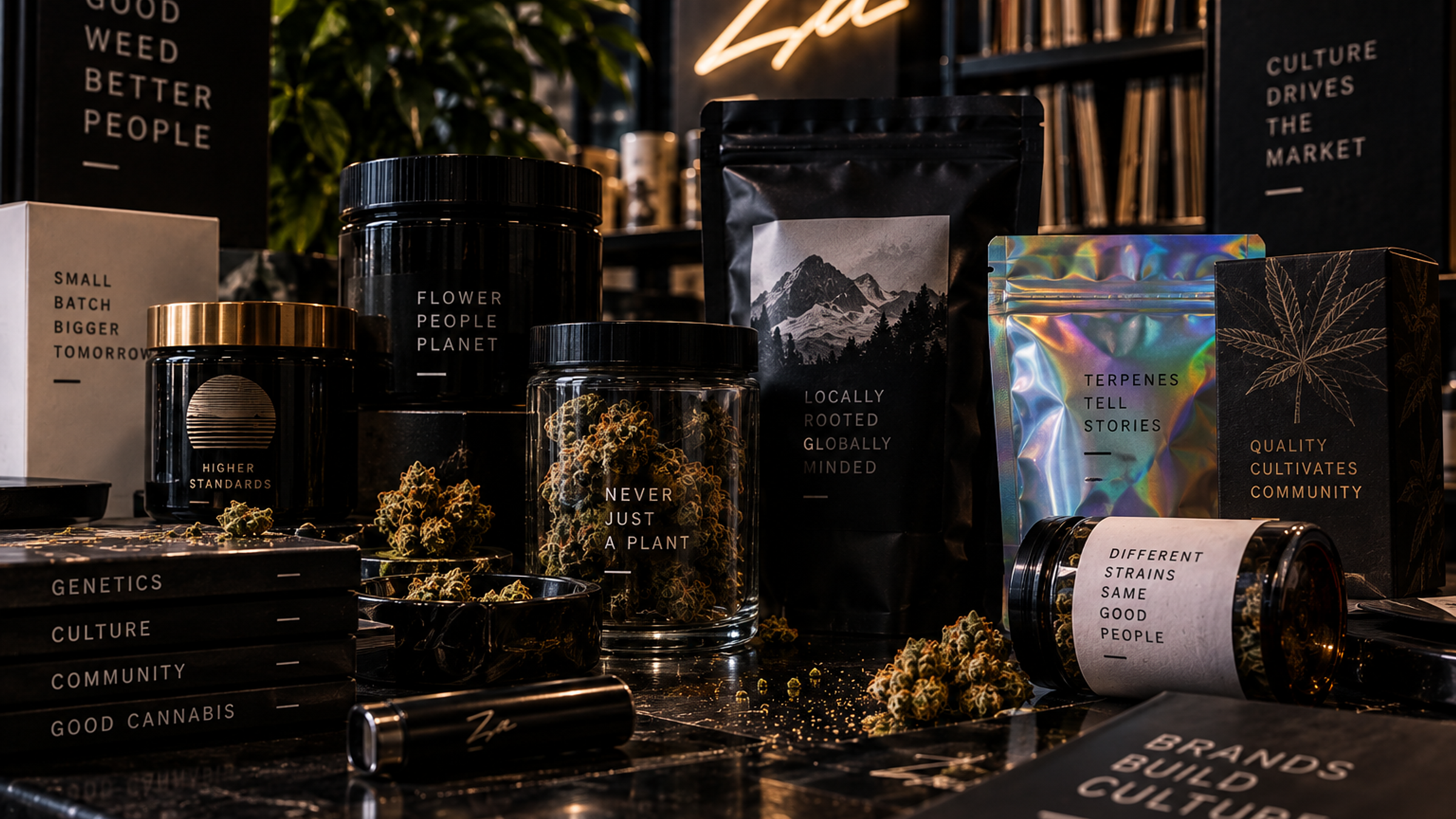
WHAT MAKES A CANNABIS BRAND WORTH REMEMBERING?
A crowded shelf can make everything look different and feel the same. The cannabis brands that last will need more than packaging, potency and a clever name.
Walk into a dispensary and look at the shelf.
Matte black jars.
Bright colors.
Metallic bags.
Characters.
Minimal typography.
Luxury cues.
Streetwear references.
Names designed to make you laugh, stop, remember or ask a question.
Everyone is trying to be different.
And when everyone is trying to be different, something strange happens.
A lot of it starts to feel the same.
Attention Isn't the Same as Memory
Packaging has a job.
It has to get noticed.
On a crowded dispensary shelf, that's not easy.
A strong color, unusual illustration or clever name might earn the first few seconds of someone's attention.
But attention and memory aren't the same thing.
The question isn't only whether someone notices your package.
It's whether they remember why they cared about what was inside it.
That's a much harder problem.
A Logo Isn't a Point of View
Cannabis has no shortage of logos.
But a recognizable mark doesn't automatically create a recognizable brand.
The brands people remember tend to develop a point of view.
Maybe it's an obsession with genetics.
Maybe it's cultivation.
Maybe it's flavor.
Maybe it's consistency.
Maybe it's a connection to a particular place or community.
Maybe it's the way the company communicates.
Whatever it is, people eventually need to understand what the name represents.
Otherwise the brand is just another package.
The Product Has to Finish the Story
Branding can create an expectation.
The product has to answer it.
Beautiful packaging can't fix forgettable flower.
A great name can't make inconsistent batches consistent.
And cultural credibility can't survive indefinitely if the product behind it doesn't deliver.
That's especially important in cannabis because consumers aren't simply buying design.
They're buying an agricultural product that can vary from harvest to harvest and batch to batch.
The strongest brands find ways to make their identity recognizable while maintaining enough consistency for consumers to trust the name.
That trust is difficult to build.
And easy to lose.
Packaging Still Matters
None of this means packaging is unimportant.
It matters enormously.
Packaging is often the first conversation between a brand and someone who has never tried it.
It communicates positioning before the package is ever opened.
Premium.
Playful.
Scientific.
Agricultural.
Street.
Wellness.
Luxury.
Local.
Mass market.
Design tells people where a product believes it belongs.
The problem begins when design becomes the entire story.
Culture Can't Be Manufactured Overnight
Cannabis and culture have been connected long before legal brands existed.
Music.
Fashion.
Art.
Language.
Neighborhoods.
Activism.
Cultivation communities.
Legacy markets.
That history makes cannabis culturally powerful.
It also makes cultural positioning tempting.
But there's a difference between participating in culture and decorating a package with cultural references.
Consumers eventually notice the difference.
Real cultural credibility tends to come from repeated participation.
Who does the brand work with?
Where does it show up?
What does it support?
Who actually uses it?
What community exists around it when the campaign is over?
Culture isn't a graphic treatment.
It's a relationship.
Consistency Builds Recognition
Think about the brands you recognize immediately.
You probably don't need to see the entire logo.
A color might be enough.
A shape.
A phrase.
A style of photography.
A particular product experience.
Recognition grows through repetition.
Cannabis brands face a difficult version of that challenge because the product itself can vary.
Different cultivars.
Different batches.
Different formats.
Different harvests.
Different producers.
That makes consistency of identity even more important.
The consumer should still understand what the brand stands for when the strain changes.
Retail Is Where the Brand Gets Tested
A cannabis brand doesn't exist only on Instagram or inside a design presentation.
Eventually it reaches a dispensary.
Now it sits beside dozens of competitors.
A budtender has to explain it.
A customer has to understand it.
The product has to justify its shelf space.
And ideally, someone comes back asking for it by name.
That's the test.
Not whether someone liked the launch post.
Whether the name survives after the first purchase.
What Are You Actually Known For?
This may be the simplest question a cannabis brand can ask.
What are we known for?
Not what does the brand deck say.
Not what does the founder want people to think.
What do customers actually associate with the name?
If the answer is unclear, more packaging probably isn't the solution.
The brand may need a stronger reason to exist.
The Brands That Last
The legal cannabis market is still young.
Some of today's most visible names will become institutions.
Others will disappear.
Some brands will change ownership.
Some will expand.
Some will lose what originally made them interesting.
And new names will keep entering the shelf.
The brands that remain memorable probably won't do it because they shouted the loudest.
They'll do it because people learned what the name meant.
A product they trusted.
A flavor they remembered.
A cultivator they followed.
A perspective they recognized.
A community they belonged to.
A story that remained coherent after the package was opened.
Because a logo can get someone's attention.
A point of view gives them something to remember.
This is The Za Report.
Cannabis. Culture. People.
The story behind the Za.
FROM THE SHELF / HOUSE OF ZA
Cannabis brands ultimately have to perform somewhere beyond the campaign. House of Za provides a ground-level view from Buffalo, where packaging, product quality, staff recommendations and customer response meet on the dispensary shelf.
EXPLORE HOUSE OF ZAHouse of Za is a founding retail collaborator of The Za Report. The Za Report is independently owned and operated. Commercial relationships do not determine editorial coverage or opinions.