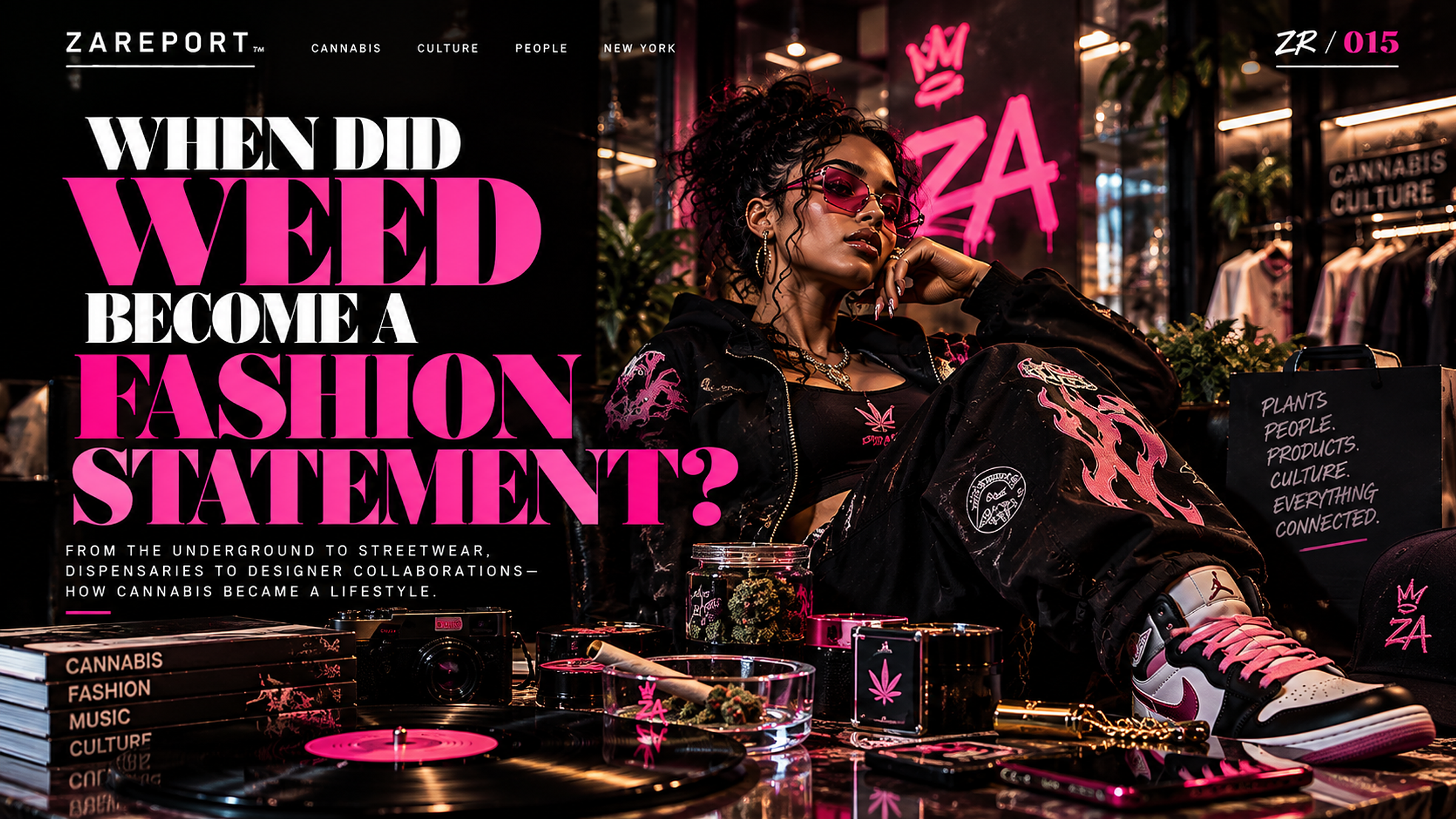
WHEN DID WEED BECOME A FASHION STATEMENT?
From underground symbolism to streetwear, designer collaborations, and lifestyle branding, cannabis has become more than a product. But who gets to define the culture, and who profits from it?
WHEN DID WEED BECOME A FASHION STATEMENT?
At some point, cannabis stopped being something people simply carried and became something they wanted to wear.
The leaf moved from rolling papers and protest posters onto designer garments, sneakers, jewelry, and carefully curated retail spaces. Dispensaries began borrowing from luxury boutiques. Cannabis companies started releasing apparel collections. Packaging became something customers photographed before they opened it.
The plant had not changed nearly as much as the presentation surrounding it.
But calling cannabis a fashion statement raises a bigger question: when a culture becomes commercially valuable, who gets to define what it looks like?
THE CULTURE CAME FIRST
Cannabis did not suddenly discover fashion when legalization arrived.
Long before licensed dispensaries, cannabis already had a visual language. Music, skateboarding, streetwear, underground publications, and neighborhood communities helped shape how the plant was represented.
In different places and eras, cannabis could signal rebellion, belonging, creativity, relaxation, political resistance, or simply a shared ritual.
That identity was built through people and communities, not marketing departments.
Hip-hop artists referenced cannabis in their lyrics and personal style. Skate and streetwear communities incorporated its imagery into graphics and clothing. Countercultural publications and independent designers used the leaf as a recognizable symbol.
None of this required a luxury label or a legal retail license.
The distinction matters because today's cannabis brands often sell an aesthetic that existed long before they entered the market.
FROM SYMBOL TO STATUS
For decades, the cannabis leaf functioned as a statement.
Wearing it could communicate a willingness to challenge convention. It could also attract unwanted attention in places where prohibition and enforcement made that association risky.
Legalization changed the commercial opportunity, but it did not erase that history.
As regulated markets developed, companies began turning familiar cultural signals into branded identities.
A recognizable logo could travel beyond the dispensary. A hoodie could advertise a company without displaying a cannabis product. A limited merchandise release could create demand among people who had never purchased the brand's flower.
Cannabis was becoming a lifestyle category.
The product still mattered, but the brand could now occupy space in someone's wardrobe, music collection, and social identity.
THE COOKIES EFFECT
Few cannabis companies illustrate the relationship between product identity and streetwear more clearly than Cookies.
Associated with rapper and entrepreneur Berner and the broader Bay Area cannabis scene, Cookies developed a recognizable visual identity that extended into clothing, accessories, retail environments, and collaborations.
Its influence was not simply that cannabis companies could sell merchandise.
It demonstrated how a cannabis name could become a recognizable cultural brand outside a dispensary.
That model helped establish a new ambition for the industry: create a brand that people recognize before they encounter the product.
Recognition can be commercially powerful. It can also complicate how consumers evaluate quality.
A familiar logo tells a story about a company. It does not independently establish the quality, freshness, genetics, or consistency of everything sold under that name.
When brand recognition becomes a major part of purchasing behavior, the distinction between cultural value and product value becomes especially important.
THE DISPENSARY AS A SHOWROOM
The transformation is visible in retail design.
Some dispensaries now borrow the visual language of fashion boutiques, galleries, and specialty concept stores.
Lighting is deliberate. Product displays are curated. Typography, architecture, uniforms, and packaging reinforce a recognizable brand experience.
Instead of simply presenting inventory, these spaces communicate taste.
This is not inherently superficial. Good retail design can make products easier to navigate, improve customer education, and create a more welcoming environment for adults who may be unfamiliar with legal cannabis.
But presentation also influences perception.
A premium-looking environment can suggest premium quality before a customer has learned anything about cultivation practices, ingredients, testing, or product performance.
The best retail experiences combine design with meaningful information. The weakest ask customers to mistake one for the other.
PACKAGING BECOMES PERSONALITY
Cannabis packaging has an unusually difficult assignment.
It must meet regulatory requirements, communicate essential product information, protect the contents, and distinguish a brand in a crowded market.
At the same time, many companies want packaging to feel collectible, recognizable, and culturally relevant.
This tension has made packaging a major part of cannabis brand identity.
Minimalist containers can suggest precision and luxury. Bold typography can signal streetwear influence. Heritage-inspired design can communicate tradition. Experimental graphics can position a product as creative or unconventional.
None of those choices necessarily tells a consumer whether the product is right for them.
A memorable package can start a conversation. It should not replace one.
THE AUTHENTICITY PROBLEM
There is a difference between participating in a culture and borrowing its appearance.
Cannabis companies frequently draw from music, fashion, art, and communities that helped normalize the plant long before legal markets existed.
The ethical question is whether those relationships are reciprocal.
Are artists being compensated for their work?
Are local communities represented in ownership, hiring, and partnerships?
Are brands acknowledging the people affected by prohibition?
Are collaborations meaningful, or are they simply a way to borrow credibility?
These questions become more urgent when companies profit from an identity that carried legal and social consequences for others.
Authenticity cannot be established by a distressed font, a graffiti wall, or a celebrity photograph.
It is reflected in relationships, decisions, and the way a business operates when no campaign is running.
THE PRICE OF BELONGING
Fashion has always been connected to identity.
People use clothing and accessories to signal taste, affiliation, aspiration, and belonging. Cannabis branding increasingly works in similar ways.
A customer may choose a brand because its imagery feels familiar, because an artist they follow supports it, or because its retail experience reflects a community they identify with.
That emotional connection can be legitimate.
The problem begins when belonging becomes a substitute for informed purchasing.
A higher price does not guarantee a better product. A recognizable name does not guarantee consistency. A fashionable collaboration does not necessarily improve what is inside the package.
Consumers can appreciate the cultural expression while still asking practical questions about product quality, transparency, and value.
Those two forms of judgment should reinforce each other, not compete.
WHAT HAPPENS NEXT?
The next phase of cannabis lifestyle branding may be less about putting a leaf on everything and more about building identities that can exist without one.
Fashion collaborations, independent publications, music programming, design objects, and community events all offer ways for cannabis-related brands to participate in culture.
Some of those efforts will be thoughtful and enduring.
Others will be short-lived attempts to turn attention into sales.
The difference will depend on whether companies create something people genuinely value beyond the transaction.
Cannabis does not need to become fashion to have cultural significance. It already had that significance.
The opportunity for the legal industry is to contribute something meaningful without pretending it invented the culture.
THE ZA REPORT TAKE
Weed did not become a fashion statement overnight.
It was already woven into music, clothing, art, and community long before legal retail turned those associations into commercial assets.
What changed was the scale of the business built around that identity.
Today, a cannabis brand can sell flower, apparel, accessories, experiences, and a particular idea of belonging.
That creates opportunity for artists, entrepreneurs, retailers, and communities. It also creates responsibility.
The question is no longer whether cannabis belongs in fashion.
It is whether the businesses benefiting from that connection are contributing to the culture or simply selling its image.
Because the strongest brands will not be the ones that look the most authentic.
They will be the ones that have something authentic to offer.
RETAIL CONNECTION/ HOUSE OF ZA
From the brands on the shelf to the design of the retail experience, cannabis culture is taking shape in New York's licensed market. Explore House of Za, a founding retail collaborator of The Za Report.
EXPLORE HOUSE OF ZAHouse of Za is a founding retail collaborator of The Za Report. The Za Report is independently owned and operated. Commercial relationships do not determine editorial coverage or opinions.