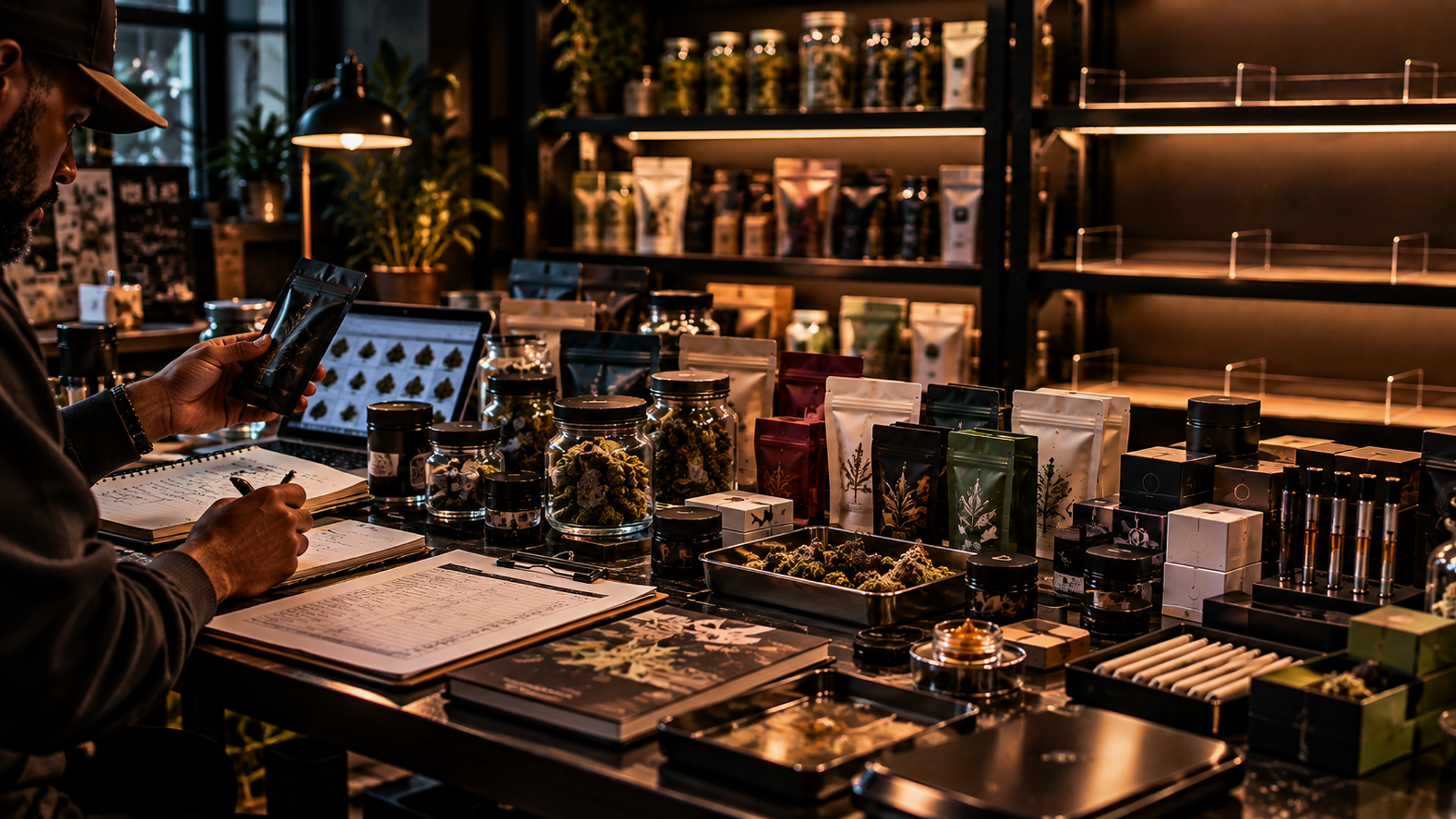
WHO DECIDES WHAT MAKES IT ONTO A DISPENSARY SHELF?
Before a product reaches a customer, someone has already made a series of decisions about price, quality, brand, inventory and whether it deserves the space.
Walk into a dispensary and the shelf can feel like the market.
Rows of flower. Pre-rolls. Vapes. Concentrates. Edibles. Different brands, different price points, different genetics and different promises competing for the same customer's attention.
But the shelf isn't the market.
It's an edit of the market.
Long before a customer decides what to buy, someone else has already decided what they will have the opportunity to see.
That makes the dispensary buyer one of the least visible but most influential people in cannabis retail.
THE SHELF HAS LIMITS
Every dispensary has finite space.
There are only so many display cases, menu positions, storage shelves and dollars available for inventory.
Meanwhile, cultivators, processors, distributors and brands are all trying to earn a place inside that limited environment.
That creates a simple reality.
Not everything can make the shelf.
Retailers have to choose.
And every choice about what comes in is also a choice about what stays out.
THE BUYER SITS IN THE MIDDLE
Cannabis buyers operate between two very different sides of the industry.
On one side are producers and distributors trying to sell products.
On the other are customers deciding what they actually want to purchase.
The buyer has to translate between them.
A product can have beautiful packaging and an enthusiastic sales representative and still sit untouched once it reaches the store.
Another product might arrive with less hype and immediately develop repeat customers.
The buyer eventually has to answer a question more important than whether a product looks interesting.
Will people buy it?
QUALITY STILL MATTERS
Sales velocity isn't the only consideration.
A serious buyer is also evaluating the product itself.
For flower, that can mean looking at genetics, aroma, appearance, cultivation, freshness, cure and overall presentation.
Other categories introduce their own considerations.
But quality doesn't exist in isolation.
A great product at the wrong wholesale price can be difficult to retail.
A good product with unreliable supply can create problems once customers begin returning for it.
A recognizable brand can attract attention, but recognition doesn't guarantee that the product will perform.
Buying is where product quality meets commercial reality.
PRICE CHANGES THE EQUATION
Every product occupies a price position.
A dispensary can't build an effective menu entirely from premium products any more than it can build one entirely from value products.
Customers arrive with different budgets and expectations.
That means buyers aren't simply asking whether something is good.
They're asking where it belongs.
What will the retail price be?
What margin does that leave?
What products already occupy that range?
Does the store need another option there?
Would customers understand why this product costs more or less than the product sitting beside it?
Price isn't just a number attached after the buying decision.
It is part of the buying decision.
THE MENU IS A PORTFOLIO
A dispensary menu works more like a portfolio than a collection.
Too much of one category creates imbalance.
Too many similar products compete against each other.
Too little variety leaves customers without meaningful choices.
A buyer may have to think across flower, pre-rolls, concentrates, vapes, edibles and other categories while also balancing price tiers, product formats, genetics and brands.
Even within flower, ten good eighths aren't necessarily ten useful additions to the menu if all ten occupy essentially the same position.
The question becomes:
What does this add that we don't already have?
BRANDS HAVE TO EARN THE SECOND ORDER
Getting onto the shelf is only the first test.
Staying there is harder.
The first order can happen because of a sales pitch, packaging, reputation, curiosity or an existing relationship.
The second order usually requires evidence.
Did it sell?
How quickly?
Did customers return for it?
Did staff recommend it?
Were there complaints?
Did the brand support the product after delivery?
Could the supplier reliably restock it?
Shelf space has an opportunity cost.
Inventory that doesn't move ties up capital and occupies space that could have gone to something customers wanted more.
Eventually every product has to justify remaining there.
BUDTENDERS CHANGE WHAT MOVES
The buyer decides what enters the store.
The staff can heavily influence what leaves it.
Budtenders occupy a unique position between inventory and consumer behavior.
They hear the questions customers repeatedly ask.
They learn which products generate excitement and which require constant explanation.
They see what people return to purchase again.
And their recommendations can turn an unfamiliar product into a successful one.
That makes staff feedback valuable information for a buyer.
A spreadsheet can show that something sold.
The people working the floor can often help explain why.
CUSTOMERS VOTE WITH THEIR BASKETS
Ultimately, customers participate in buying decisions whether they realize it or not.
Every purchase produces information.
So does every product someone picks up and puts back down.
Every request for a brand the store doesn't carry is information.
Every customer asking for a particular genetic, format, price point or producer is information.
Over time, those signals shape future orders.
The shelf changes because the customer changes it.
DISTRIBUTORS SHAPE THE OPTIONS TOO
Retail selection doesn't begin at the dispensary door.
Distribution, availability and logistics influence what retailers can realistically buy.
A product may be interesting but unavailable through the channels a store currently works with.
A brand may struggle to maintain inventory.
Minimum orders, delivery schedules, payment terms and geographic coverage can all affect whether a product makes sense operationally.
That means the shelf isn't shaped by taste alone.
It is also shaped by infrastructure.
NEW YORK MAKES THE PROCESS MORE INTERESTING
New York's legal cannabis market is still developing.
New cultivators, processors and brands continue competing for recognition while retailers learn what their local customers actually respond to.
That makes dispensary shelves useful snapshots of the market at a particular moment.
Products appear.
Some disappear.
Some brands expand.
Others are replaced.
Certain genetics suddenly seem to be everywhere.
New categories gain attention.
The shelf becomes a record of what the industry is producing and what consumers are rewarding.
THE BEST SHELF ISN'T THE BIGGEST SHELF
More products do not automatically create a better dispensary.
At some point, abundance becomes noise.
A well-built shelf gives customers meaningful choices without making every decision feel impossible.
That requires curation.
Different price points.
Different experiences.
Products the staff understands.
Products customers return for.
And enough room for something unexpected to earn a chance.
LOOK AT THE SHELF DIFFERENTLY
The next time you walk into a dispensary, look beyond the individual packages.
Look at the collection.
Which brands appear repeatedly?
Which categories receive the most space?
Where are the premium products?
Where are the value products?
What seems unusual?
What seems missing?
Those patterns didn't happen accidentally.
Every shelf tells you something about the retailer, the market around it and the customers it serves.
Before you choose what to buy, someone chose what you would see.
FROM THE BUYER'S DESK / HOUSE OF ZA
Retail buying turns cannabis market trends into real shelf decisions. House of Za provides The Za Report with a ground-level view from Buffalo, where products, pricing, inventory, staff feedback and customer demand meet inside New York's legal cannabis market.
EXPLORE HOUSE OF ZAHouse of Za is a founding retail collaborator of The Za Report. The Za Report is independently owned and operated. Commercial relationships do not determine editorial coverage or opinions.