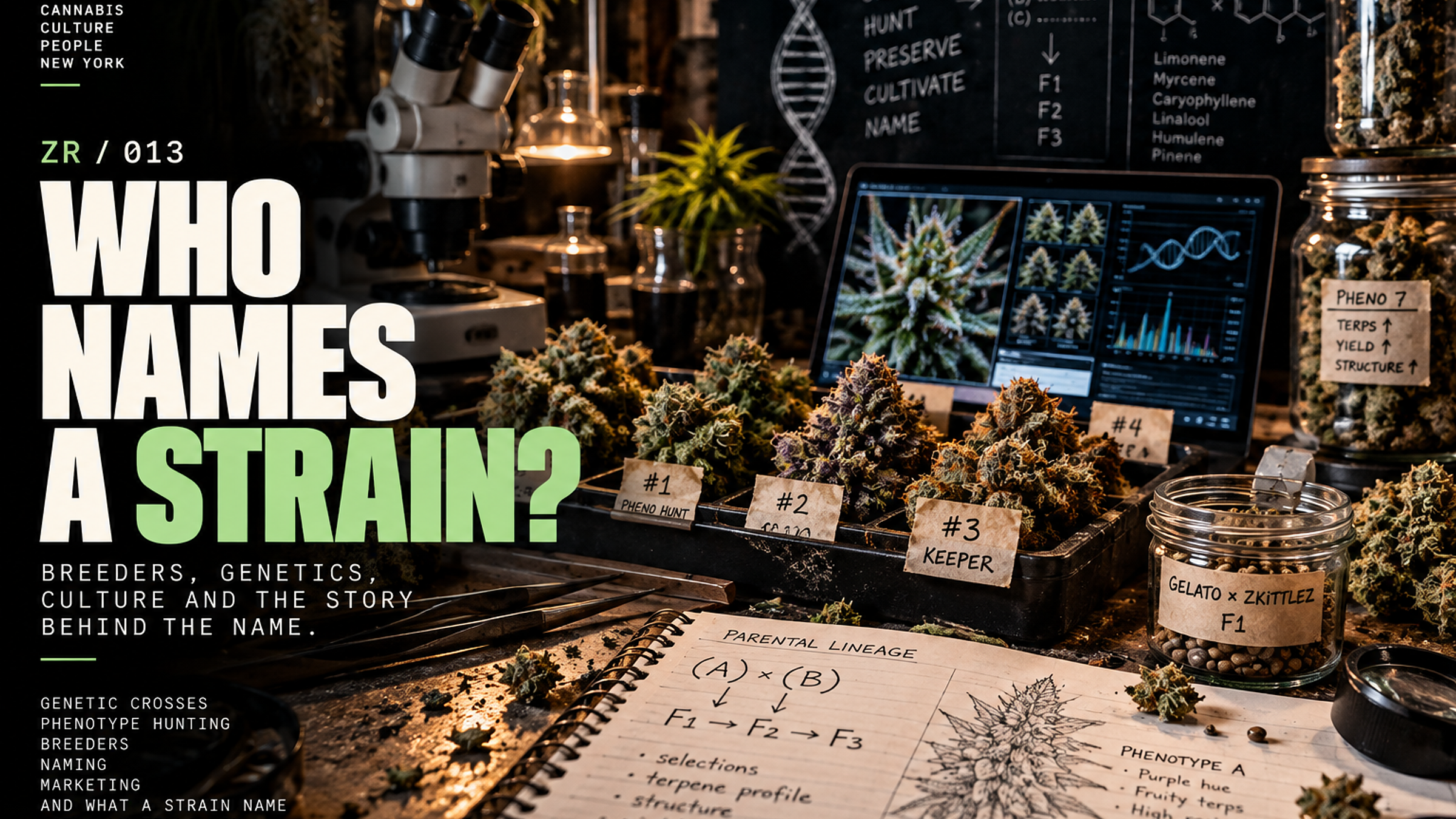
WHO NAMES A STRAIN?
Before Gelato, Runtz or Sour Diesel becomes a name on a dispensary menu, somebody has to decide what to call the plant. That decision can carry genetics, history, flavor, culture and increasingly, marketing.
WHO NAMES A STRAIN?
Walk into a dispensary and you will encounter names that sound more like a dessert menu, a music playlist or a collection of inside jokes than a botanical catalog.
Gelato. Runtz. Sour Diesel. Wedding Cake. Permanent Marker.
Some names suggest flavor. Others reference a place, a person, a feeling or a cultural moment. A few become so recognizable that the name itself begins to carry commercial value.
But who actually decides what a cannabis strain is called?
THE NAME STARTS WITH THE BREEDER
For a newly developed cannabis cultivar, the naming process often begins with the breeder.
Breeders select parent plants for characteristics they want to combine or explore. Those characteristics might include aroma, plant structure, flowering behavior, resin production, coloration, or other observable traits.
Crossing two plants produces offspring with genetic variation. Even plants from the same cross can express noticeably different characteristics.
This is where breeding becomes a process of observation, selection, documentation and repetition.
The breeder is not simply inventing a catchy name. Ideally, they are identifying something worth preserving.
THE PHENOTYPE HUNT
Imagine a breeder growing dozens of plants from seeds produced by the same cross.
They share parentage, but they are not necessarily identical.
One plant might express a particularly distinctive aroma. Another might develop an unusual color. A third might have the structure or growth characteristics the breeder has been seeking.
The process of evaluating those differences is commonly called phenotype hunting, or pheno hunting.
Breeders may identify promising selections with numbers before assigning a commercial name.
That is why cannabis culture includes names such as Gelato #33 and Gelato #41.
Those numbers can reflect different selections within a breeding project, not merely different packages of the same flower.
The work behind a name can involve substantial time, space, labor and repeated evaluation.
A memorable name may be the last step in a much longer process.
WHO MAKES IT OFFICIAL?
There is no single universal authority that approves every cannabis strain name used in the marketplace.
Breeders, cultivators, brands and commercial operators may all influence the names consumers encounter.
A breeder might introduce a cultivar under one name. A different producer might use an existing name for a product they believe shares the same genetic lineage. Another might market a selection under a new name.
Naming practices also vary across markets and operators.
That creates an important distinction: a strain name is not automatically a verified genetic certificate.
Two products carrying the same familiar name may differ in their source material, growing conditions, handling, and resulting characteristics.
A name can communicate a claimed lineage or recognizable identity, but it cannot tell the entire story of the flower inside the package.
WHEN GENETICS BECOME CULTURE
Some strain names become bigger than the plants they originally described.
They move through dispensaries, music, social media, conversations and regional communities.
Names like Sour Diesel and Gelato have become part of the vocabulary of cannabis culture.
They can evoke a particular era, a regional identity or a remembered experience.
That cultural recognition gives names influence.
A consumer who has enjoyed a particular cultivar before may look for the same name again. A retailer may recognize that demand. A brand may see an opportunity to connect its product to something familiar.
The name becomes a bridge between the grower, the shelf and the consumer.
But familiarity is not the same as consistency.
THE MARKETING QUESTION
A good strain name is easy to remember.
A great one can travel.
That makes naming a powerful branding decision, especially as the legal cannabis marketplace becomes more competitive.
Names can suggest sweetness, intensity, exclusivity, nostalgia or novelty before a customer ever smells the flower.
There is nothing inherently wrong with memorable branding. Cannabis has always had a creative naming culture.
The problem arises when the name becomes a substitute for meaningful product information.
A recognizable label cannot independently establish quality, freshness, chemical composition or how a particular consumer will experience the product.
Marketing can create an expectation.
The actual flower still has to meet it.
WHAT SHOULD THE CONSUMER LOOK FOR?
Start with the name, but do not stop there.
Look for information about the cultivator or producer. Ask about the product's lineage when that information is available. Pay attention to freshness, aroma, appearance and other verifiable product details.
Cannabinoid and terpene testing may provide additional context, but no single number can fully predict an individual's experience.
If you find a product you genuinely enjoy, remember more than its strain name.
Remember who produced it.
The same name from a different producer, harvest or growing environment may not deliver an identical result.
THE STORY BEHIND THE LABEL
Cannabis naming sits at the intersection of science, agricultural labor, creativity and commerce.
A breeder may spend considerable time selecting a plant. A cultivator may work to preserve and express its characteristics. A brand may introduce it to a wider audience. Consumers may eventually give that name cultural meaning.
Each stage contributes to the story.
The most interesting question is not simply who invented the name.
It is whether the name still connects to the work, genetics and product that made it meaningful in the first place.
A strain name can tell you where a story started. The flower still has to tell you how it ended.
FROM NAME TO SHELF
A familiar strain name is only one part of the story. Explore New York's licensed cannabis marketplace and learn more about the producers, products and cultivars reaching local shelves through House of Za in Buffalo.
EXPLORE HOUSE OF ZAHouse of Za is a founding retail collaborator of The Za Report. The Za Report is independently owned and operated. Commercial relationships do not determine editorial coverage or opinions.