WHY FRESHNESS MATTERS MORE THAN MOST CANNABIS SHOPPERS REALIZE
Cannabis doesn't stop changing when it enters the package. Time, light, air, humidity and storage all help determine how much of the flower's original quality reaches you.
Cannabis doesn't stop changing when it reaches the package.
The flower sitting on a dispensary shelf has already been through months of development. It was grown, harvested, dried, cured, processed, packaged, transported and stored before it ever reached the person buying it.
And the clock kept moving through all of it.
Consumers are trained to look at THC percentages, strain names, genetics and brands. Those things provide information. But there's another piece of the quality conversation sitting quietly on the label:
Time.
A great flower can begin with excellent genetics and careful cultivation and still arrive differently depending on what happened after harvest.
Freshness doesn't tell you everything about cannabis.
But it can tell you something worth knowing.
## Cannabis Is Still Changing
Harvesting cannabis ends the plant's growing cycle. It doesn't freeze the flower in its current state.
The material continues to change after harvest as it dries, cures, ages and interacts with its environment.
That process isn't automatically bad.
Drying and curing are essential parts of preparing cannabis flower. Done properly, they help stabilize the flower and develop characteristics that weren't present in exactly the same way when the plant was freshly cut.
But there is a difference between properly cured and indefinitely preserved.
Cannabis is an agricultural product.
And agricultural products change with time.
## What Happens After Harvest?
Once cannabis is harvested, several variables begin influencing what happens next.
Oxygen. Light. Temperature. Humidity. Time.
Each can affect the chemical and physical characteristics of stored flower.
Terpenes are volatile compounds, meaning they can evaporate or degrade over time. Cannabinoids can also change through exposure to environmental conditions. Meanwhile, moisture can move into or out of the flower depending on how it is stored.
That's why the same flower can seem different months later even though the strain name and printed potency haven't changed.
The label may be identical.
The flower isn't necessarily identical anymore.
## The Package Isn't a Time Capsule
Packaging protects cannabis.
It does not stop time.
A sealed jar or pouch can help control exposure to the outside environment, but the conditions surrounding that package still matter.
Light exposure can contribute to degradation. Excessive heat can accelerate chemical changes. Too much air exchange can contribute to drying and oxidation. Poor moisture control can create its own problems.
Packaging material matters too.
Glass, plastic and multilayer pouches don't interact with their contents or surrounding environment in exactly the same way.
None of this means consumers need to become packaging engineers.
It simply means that how cannabis is stored after production is part of the product story.
## Terpenes Don't Wait Forever
Terpenes are responsible for much of the aroma associated with cannabis.
Citrus. Pine. Fuel. Fruit. Earth. Floral notes.
That aromatic profile is one reason opening a container can sometimes tell you something the THC number cannot.
But terpenes don't exist in a permanent state.
Because many are volatile, their concentration and expression can change with time and environmental exposure.
A flower that once had a loud, distinct aroma may become quieter as it ages or if it has been poorly stored.
That doesn't create a universal rule that stronger-smelling cannabis is always better.
It does mean aroma can provide another piece of information about the condition of the flower in front of you.
Your nose isn't reading a laboratory result.
It's encountering the product as it exists right now.
## Moisture Is a Balance
Freshness doesn't mean wet.
Proper cannabis flower needs to be dried and cured. Excess moisture is not a sign of superior quality and can create serious storage problems.
At the other extreme, flower that loses too much moisture can become brittle and excessively dry.
The goal is stability.
That balance is one reason storage conditions matter so much. Humidity, temperature, packaging and time interact rather than operating independently.
So when people talk about "fresh weed," what they usually want isn't flower that was harvested yesterday.
They want flower whose desirable characteristics have been properly preserved.
That's an important distinction.
## What Can the Dates Tell You?
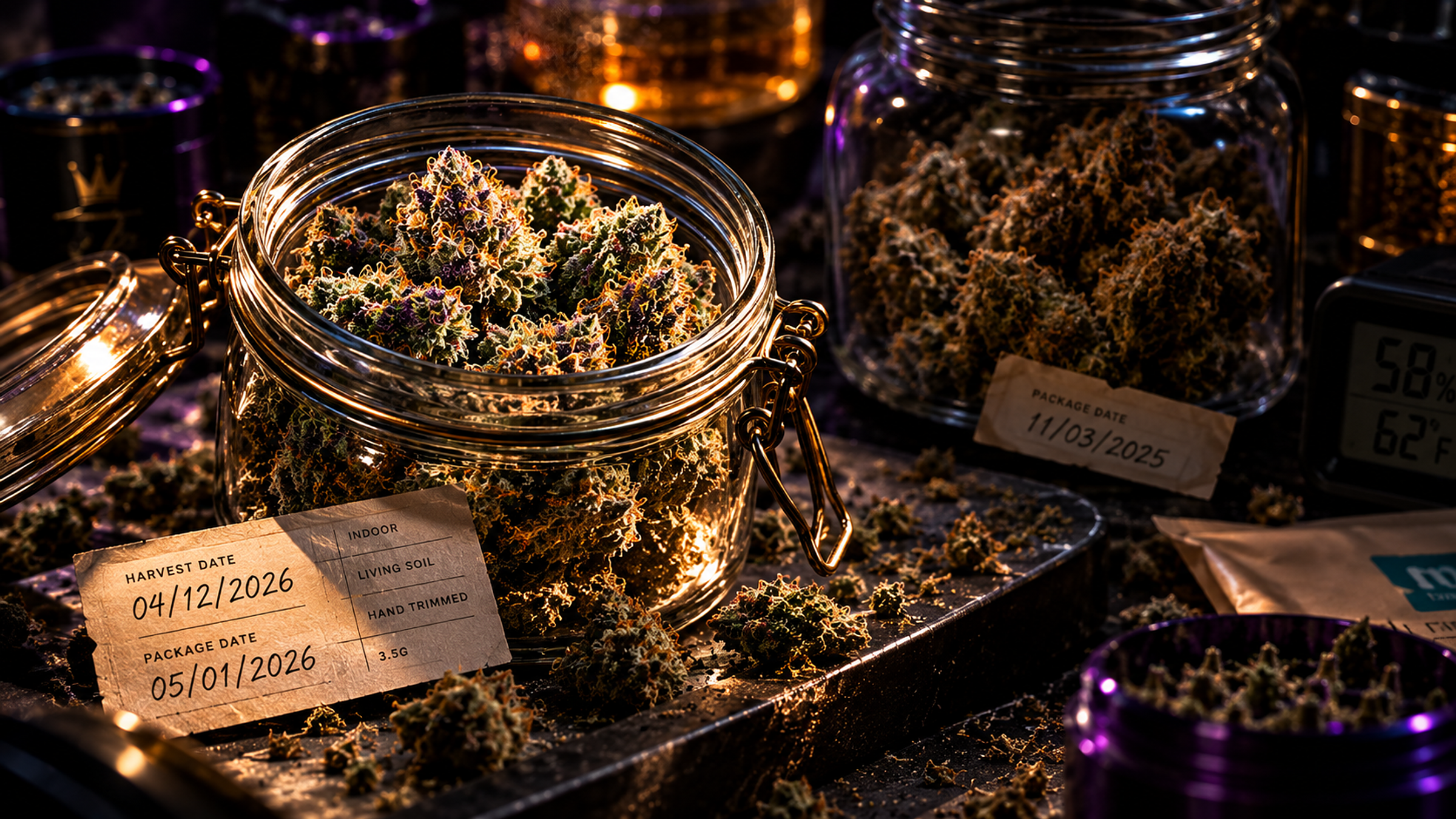
Depending on the market and product, cannabis packaging may include dates associated with harvest, testing, processing or packaging.
Those dates aren't interchangeable.
A harvest date tells you when the plant was harvested.
A package date tells you when the finished product entered its package.
A testing date tells you when the sampled material went through laboratory analysis.
Together, those dates can provide context.
But they still don't tell the entire story.
A product packaged recently may have been harvested much earlier. Older flower that was dried, cured and stored properly may be in better condition than newer flower that was handled poorly.
The date is evidence, not a verdict.
## Fresh Doesn't Automatically Mean Better
This is where freshness can become another misleading shortcut.
If consumers simply replace:
"Highest THC = best"
with:
"Newest package = best"
we haven't learned much.
Quality begins much earlier.
Genetics matter. Cultivation matters. Harvest timing matters. Drying matters. Curing matters. Processing matters. Storage matters.
Freshness tells us something about how much time has passed and, sometimes, how well certain qualities may have survived that time.
It cannot rescue poorly grown flower.
And age alone doesn't erase good cultivation.
The better question isn't simply:
How new is it?
It's:
How well has it been preserved?
## Look Beyond the Number
Cannabis consumers have more information available to them than ever.
Potency.
Cannabinoid profiles.
Terpenes.
Genetics.
Cultivator.
Processor.
Harvest dates.
Package dates.
None of those data points should have to carry the entire definition of quality by itself.
They work better as pieces of a larger picture.
That's the same reason THC shouldn't be treated as a universal score and strain names shouldn't be treated as guarantees.
Freshness belongs in that conversation too.
The next time you're looking at flower, look beyond the biggest number on the package.
Look at the dates.
Look at the flower.
Pay attention to the aroma.
Ask how the product has been stored.
Then put those pieces together.
Because cannabis quality isn't created at the dispensary shelf.
By the time it gets there, part of the question is how much of that quality survived the journey.
Quality begins before the package. Freshness helps determine how much of it reaches you.
FROM THE SHELF / HOUSE OF ZA
Freshness becomes practical at the dispensary shelf. House of Za provides a ground-level view in Buffalo, where package dates, storage, product turnover and customer questions all become part of evaluating cannabis beyond the THC number.
EXPLORE HOUSE OF ZAHouse of Za is a founding retail collaborator of The Za Report. The Za Report is independently owned and operated. Commercial relationships do not determine editorial coverage or opinions. Hero Media