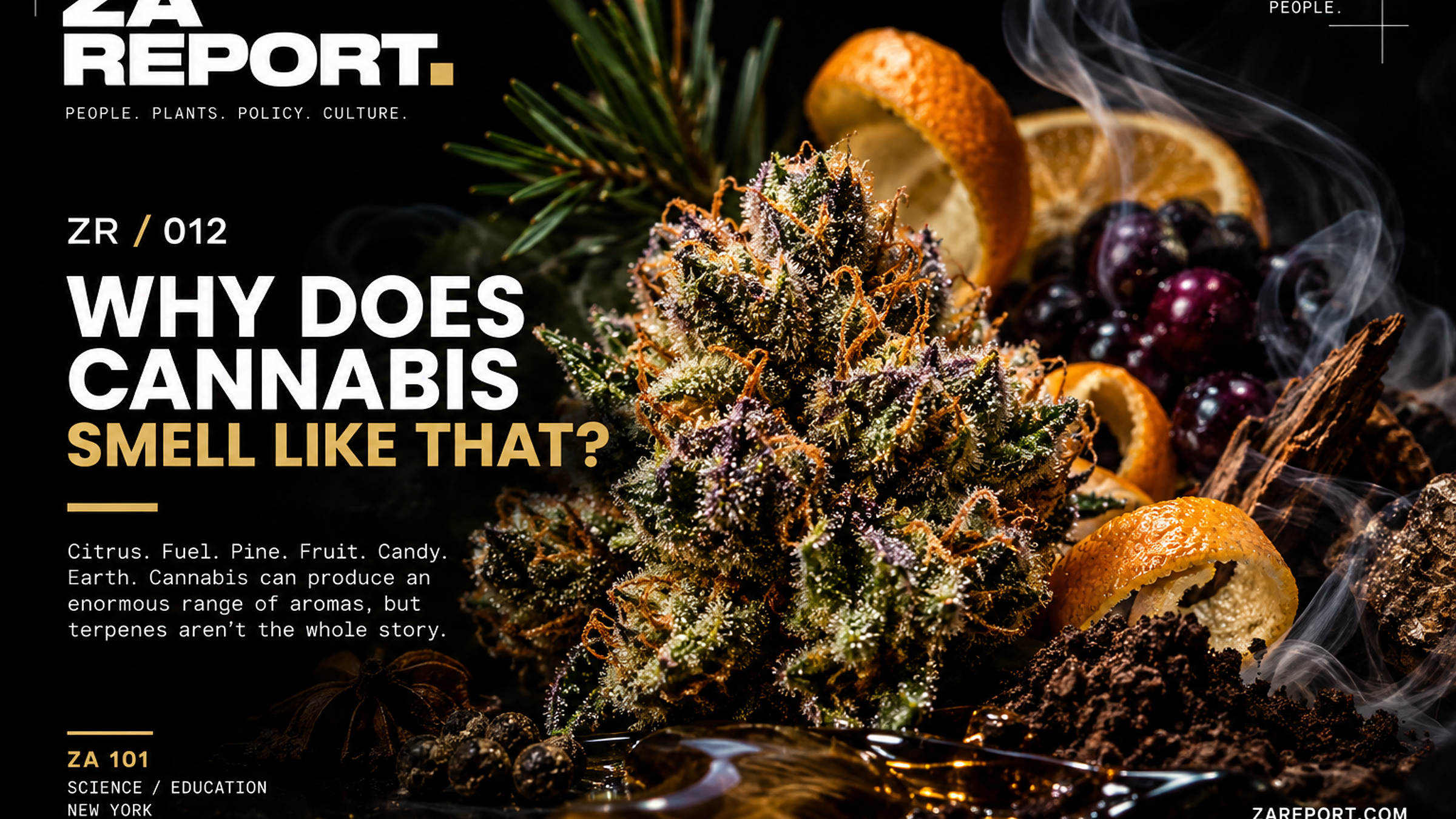
WHY DOES CANNABIS SMELL LIKE THAT?
Cannabis can smell like citrus, fuel, pine, fruit, candy, earth and things that are harder to name. Terpenes explain part of that spectrum. The chemistry of cannabis aroma goes further.
WHY DOES CANNABIS SMELL LIKE THAT?
Open one jar and you might get citrus.
Another smells like pine.
Another might remind you of berries, candy, fuel, earth, garlic or something you cannot quite name.
That range is one of the most distinctive characteristics of cannabis.
It is also more chemically complicated than the usual explanation suggests.
For years, much of the conversation around cannabis aroma has centered on one word:
Terpenes.
Terpenes matter.
But they are not the whole story.
THE AROMA IS CHEMISTRY
What you smell when you open a container of cannabis is the result of volatile compounds leaving the flower and reaching receptors in your nose.
Volatile simply means that a compound can readily enter the air under ordinary conditions.
Cannabis produces a complicated mixture of them.
Some are present in relatively large amounts.
Others may exist at extremely low concentrations while still making a noticeable contribution to what you smell.
Together, they create the aromatic fingerprint of the flower.
TERPENES ARE PART OF THE PICTURE
Terpenes are naturally occurring compounds produced by many plants.
They are not unique to cannabis.
Limonene is associated with citrus-like aromas.
Pinene can smell like pine.
Linalool is often described as floral.
Myrcene can contribute earthy, musky or fruity characteristics.
Caryophyllene is commonly associated with peppery or spicy notes.
Cannabis can contain many different terpenes in different concentrations and combinations.
That makes terpene analysis useful.
But knowing the dominant terpenes does not necessarily tell you exactly what the flower will smell like.
THE SMALL STUFF CAN SMELL BIG
This is where cannabis aroma gets more interesting.
Researchers analyzing cannabis with increasingly sensitive instruments have identified minor compounds that can have enormous sensory impact despite appearing in very small concentrations.
Volatile sulfur compounds are one example.
Certain sulfur-containing molecules have been associated with the characteristic skunky or pungent aroma found in some cannabis.
Other research has identified sulfur compounds associated with tropical and citrus-like aromas.
Compounds outside the terpene family have also been associated with savory, chemical and other distinctive aromatic characteristics.
In other words, two samples can share similar dominant terpene profiles and still smell remarkably different.
The difference may be hiding in compounds that barely register by quantity.
YOUR NOSE DOES NOT READ PERCENTAGES
A laboratory can measure how much of a compound is present.
Your nose experiences how strongly that compound smells.
Those are not necessarily the same thing.
Some aromatic compounds can influence perception at extremely low concentrations.
That means the compound present in the greatest quantity is not automatically the compound dominating your sensory experience.
A terpene panel can therefore provide useful information without functioning as a complete map of the aroma inside the package.
This is one reason smelling the actual flower can reveal information that a label cannot.
WHY DOES SOME CANNABIS SMELL SKUNKY?
The famous skunk association is not just cannabis folklore.
Research has identified a family of volatile sulfur compounds associated with the characteristic pungent, skunk-like aroma of cannabis.
One compound in particular, 3-methyl-2-butene-1-thiol, has shown a strong relationship with that aroma in analyzed cultivars.
Sulfur chemistry should sound familiar.
Potent sulfur-containing compounds also help create distinctive aromas in foods and plants including garlic.
A molecule does not have to exist in huge quantities to announce itself.
WHAT ABOUT FRUIT AND CANDY?
Fruit-forward cannabis can be complicated too.
Some of those impressions can involve familiar terpenes.
But researchers have also identified minor volatile compounds associated with tropical, citrus and other fruit-like characteristics.
That helps explain an observation cannabis consumers have made for years:
Two flowers can show similar headline terpenes on paper and smell nothing alike when you open the jars.
The aroma is being created by the complete volatile mixture, not merely the three compounds printed most prominently on a label.
GENETICS START THE CONVERSATION
Genetics help determine what chemistry a cannabis plant is capable of producing.
But genetics do not operate alone.
Cultivation conditions can influence plant development and chemical production.
Harvest timing matters.
Drying matters.
Curing matters.
Storage matters.
Temperature, oxygen, light and time can alter or reduce volatile compounds after harvest.
The aroma reaching your nose is therefore not simply a genetic trait.
It is the result of genetics, cultivation and everything that happened to the flower afterward.
FRESHNESS HAS A SMELL
This connects aroma directly to freshness.
Volatile compounds can be lost or transformed over time.
Poor storage can accelerate that process.
A flower that once had a vivid aromatic profile can become muted as some of those compounds disappear or change.
That does not mean smell alone can tell you everything about cannabis quality.
It means aroma provides another piece of information about the condition of the flower in front of you.
THE TERPENE LABEL IS A STARTING POINT
None of this makes terpene testing useless.
Quite the opposite.
Terpene profiles give consumers and researchers another way to describe and compare cannabis chemistry.
The mistake is treating them as the complete explanation.
Cannabis contains hundreds of identified chemical constituents, and researchers are still working to understand how its volatile chemistry translates into the aromas people actually perceive.
The science is becoming more detailed.
Our language should become more detailed with it.
SMELL THE WHOLE FLOWER
Cannabis aroma is not one molecule.
It is not one terpene.
It is not necessarily the compound with the largest percentage on the certificate of analysis.
It is a chemical composition experienced all at once by the human nose.
Citrus.
Fuel.
Pine.
Fruit.
Earth.
Skunk.
Candy.
And sometimes something for which we do not have a particularly good word yet.
The laboratory can separate those signals into individual compounds.
Your nose encounters the composition.
The nose doesn't read a lab label.
It experiences the whole flower.
FOLLOW YOUR NOSE / HOUSE OF ZA
Aroma is one of the ways consumers experience cannabis beyond the numbers on a label. House of Za provides The Za Report with a ground-level view from Buffalo, where genetics, freshness, storage and the sensory differences between products become part of everyday cannabis discovery.
EXPLORE HOUSE OF ZAHouse of Za is a founding retail collaborator of The Za Report. The Za Report is independently owned and operated. Commercial relationships do not determine editorial coverage or opinions.