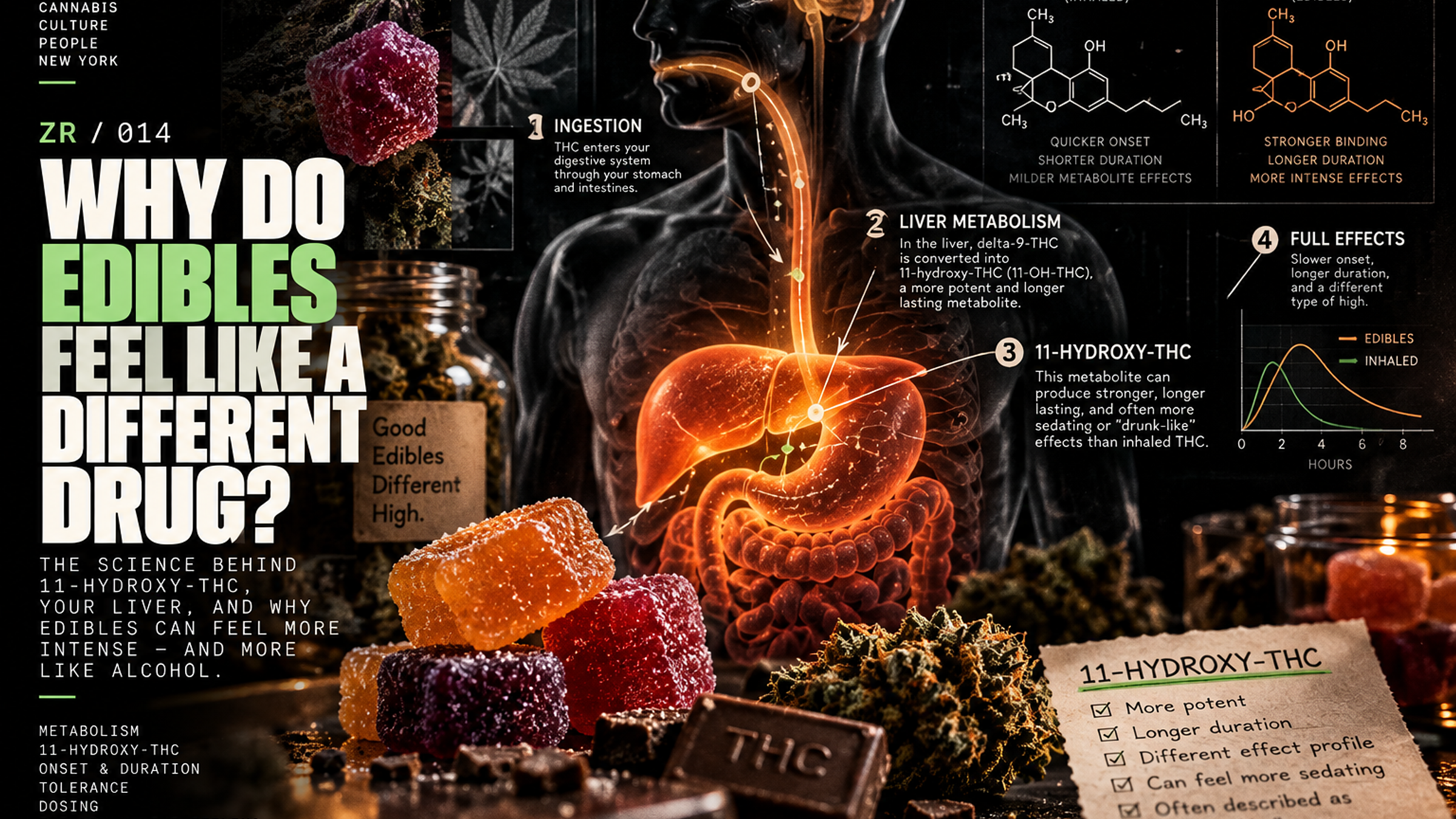
WHY DO EDIBLES FEEL LIKE A DIFFERENT DRUG?
Edibles and smoked cannabis contain the same familiar THC, but they can produce remarkably different experiences. The explanation begins with absorption, liver metabolism, and a compound called 11-hydroxy-THC.
WHY DO EDIBLES FEEL LIKE A DIFFERENT DRUG?
You eat a cannabis gummy. An hour passes. Nothing much happens.
Then, somewhere between the second hour and the moment you decide to stand up, the experience changes.
Your body feels heavier. Time seems to stretch. Your coordination is a little less reliable. What began as a familiar cannabis experience suddenly feels almost like alcohol intoxication.
It raises a reasonable question: if smoking and edibles both involve THC, why can they feel so different?
The answer is not simply that edibles are stronger. It has a lot to do with how THC enters the bloodstream, what happens in the liver, and how long the body takes to process it.
TWO ROUTES, TWO EXPERIENCES
When cannabis is smoked or vaporized, THC enters the bloodstream through the lungs. Its effects can begin within seconds or minutes, giving the consumer relatively immediate feedback about the experience.
Edibles take a different route.
THC must pass through the digestive system before entering circulation. Some of it is metabolized by the liver before reaching the rest of the body, a process known as first-pass metabolism.
That difference changes the timing and chemical profile of the experience.
An inhaled cannabis experience often peaks relatively quickly and begins declining within a few hours. An edible may take 30 minutes to two hours or longer to become noticeable, peak several hours after consumption, and remain active for six to eight hours or more.
That delayed timeline is one of the biggest reasons edibles can catch people off guard.
MEET 11-HYDROXY-THC
When the liver metabolizes delta-9-tetrahydrocannabinol, commonly called delta-9-THC, it produces several metabolites.
One of the most important is 11-hydroxy-THC, or 11-OH-THC.
Unlike many substances produced during drug metabolism, 11-hydroxy-THC is itself psychoactive. It contributes to the effects of THC and can influence the intensity and character of an edible experience.
Research suggests that 11-hydroxy-THC can be highly psychoactive, but it would be misleading to claim that every edible produces a stronger high simply because this metabolite is present.
The amount formed varies between individuals. So do absorption, tolerance, dose, and the resulting subjective experience.
The important distinction is that eating THC changes the proportions and timing of the active compounds circulating through the body.
WHY DOES IT SOMETIMES FEEL LIKE BEING DRUNK?
Cannabis and alcohol work through different pharmacological mechanisms. They are not interchangeable substances.
But some of their effects overlap.
THC can interfere with attention, reaction time, coordination, balance, and short-term memory. At higher levels of intoxication, those effects may become especially noticeable.
That can produce sensations people associate with drunkenness: heavy limbs, unsteady movement, slowed thinking, dizziness, and difficulty tracking time.
Edibles may make these sensations feel more pronounced because their effects develop gradually, can persist for hours, and are harder to adjust once the dose has been swallowed.
Someone who feels comfortable after a few inhalations may be surprised by an edible containing a substantial amount of THC.
The difference does not necessarily mean that the edible contains a different drug. It means the same starting compound has entered the body through a different metabolic pathway.
THE DELAYED-ONSET TRAP
One of the most consequential differences between smoking and eating cannabis is the feedback loop.
With inhalation, effects arrive quickly enough that someone can often recognize increasing intoxication before deciding whether to consume more.
With edibles, the absence of an immediate effect can create a false impression that the dose was insufficient.
Taking another serving before the first has peaked can result in overlapping effects and unexpectedly intense intoxication.
Food intake, product formulation, individual metabolism, and previous cannabis exposure can all influence the timeline.
This variability is why two people can consume the same edible and report very different experiences.
DOES TOLERANCE TRANSFER?
Tolerance to cannabis is not an all-or-nothing characteristic.
Someone who regularly smokes cannabis may have developed tolerance to certain THC effects. But that does not guarantee they can predict their response to an edible.
Oral absorption, metabolite formation, and the much longer period of exposure can make familiar THC feel unfamiliar.
Similarly, an individual who tolerates a particular edible dose may not respond identically to another product with the same labeled THC amount.
Formulation matters, and individual responses remain variable.
THE NUMBERS DON'T TELL THE WHOLE STORY
Cannabis conversations often reduce potency to a single number.
Flower gets compared by THC percentage. Edibles get compared by milligrams.
Both measurements are useful, but neither fully predicts the experience.
A 10-milligram edible is not directly equivalent to inhaling 10 milligrams of THC. The amount that reaches circulation, the rate at which it arrives, and the metabolites formed can differ substantially.
That makes the route of administration part of the product experience, not merely a different delivery method.
WHAT CONSUMERS SHOULD UNDERSTAND
Edibles deserve patience and careful dosing, particularly for people who are inexperienced with oral THC.
For adults who choose to consume them, starting with a low dose and waiting long enough for the full effects to develop helps reduce the risk of unintended overconsumption. Mixing cannabis with alcohol can further increase impairment.
Cannabis intoxication can affect judgment and coordination even when someone feels relatively comfortable. Driving or operating machinery while impaired is unsafe.
Severe confusion, chest pain, trouble breathing, or loss of consciousness warrant urgent medical attention.
Understanding these risks is not about treating edibles as inherently dangerous. It is about recognizing that their pharmacology makes them less immediately predictable than inhaled cannabis.
THE SAME PLANT, A DIFFERENT JOURNEY
The distinction between smoking and eating cannabis reveals something important about the relationship between a substance and the human body.
The experience is not determined by the plant alone.
It is shaped by absorption, metabolism, dose, time, individual physiology, and the context in which the substance is consumed.
An edible does not have to contain a mysterious ingredient to feel dramatically different from flower.
Sometimes the biggest difference is what happens after THC leaves the product and enters the body.
Same molecule. Different route. Different experience.
FROM SCIENCE TO SHELF
Cannabis comes in different formats, and understanding how those formats work is part of making informed decisions. House of Za is a licensed New York cannabis retailer and founding retail collaborator of The Za Report.
EXPLORE HOUSE OF ZAHouse of Za is a founding retail collaborator of The Za Report. The Za Report is independently owned and operated. Commercial relationships do not determine editorial coverage or opinions.