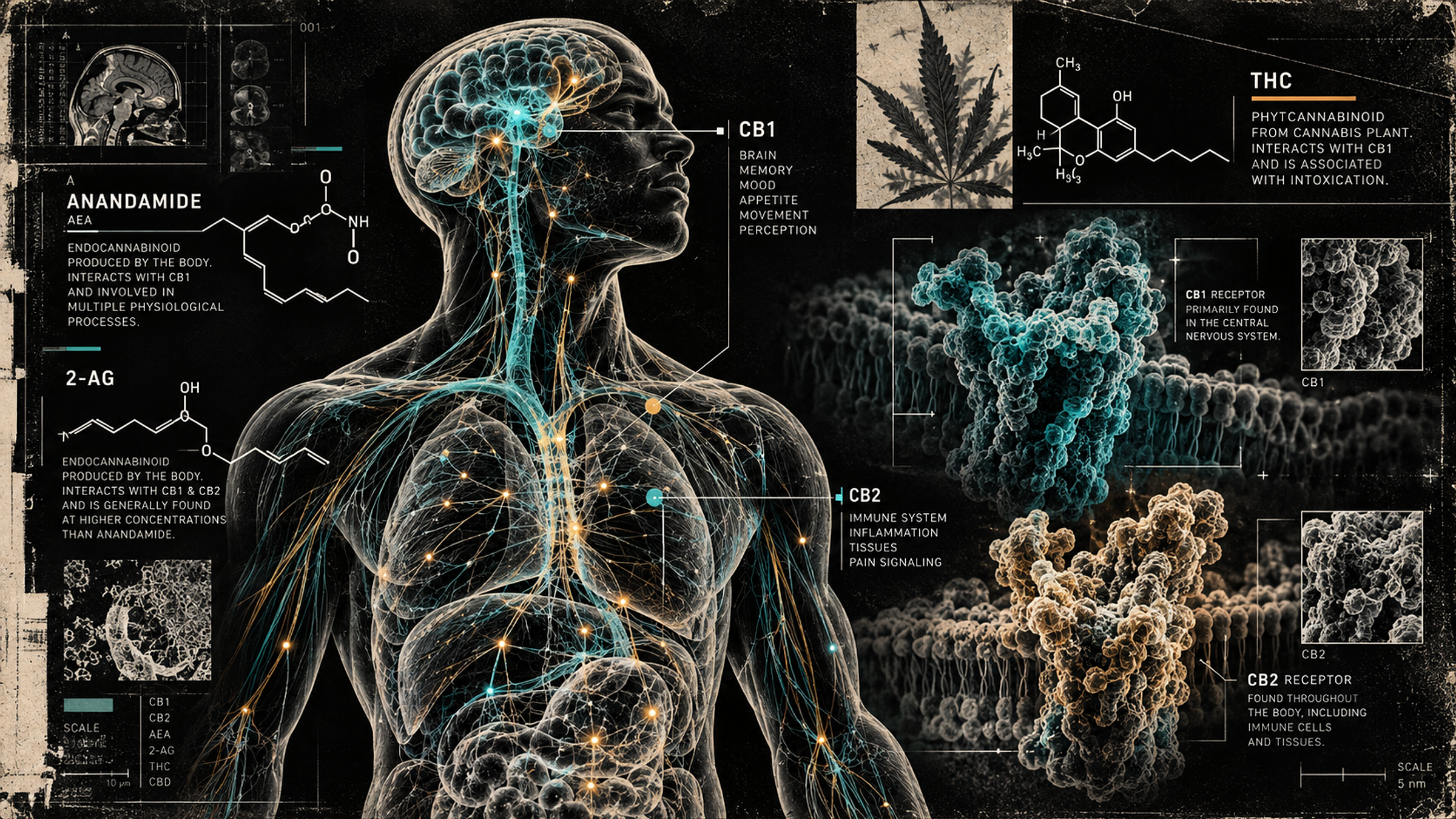
YOUR BODY MAKES CANNABINOIDS TOO
Long before cannabis enters the picture, the human body is already producing cannabinoid-like chemical messengers of its own.
Cannabis didn't create the cannabinoid system in your body.
It found one that was already there.
Long before THC enters the bloodstream, the human body is producing its own chemical messengers that interact with a network of receptors spread throughout the brain and body.
They're called endocannabinoids.
And understanding them helps answer one of the most basic questions about cannabis:
Why does this plant affect us at all?
THE SYSTEM WAS ALREADY THERE
The human body contains something called the endocannabinoid system, often shortened to ECS.
It is a biological signaling system involving cannabinoid receptors, naturally produced signaling molecules and enzymes that create and break those molecules down.
Scientists didn't discover this system because they were looking for a cannabis receptor system.
They encountered it while trying to understand how compounds from cannabis interact with the body.
That distinction matters.
The system isn't there for cannabis.
Cannabis happens to contain molecules capable of interacting with a system that was already part of human biology.
MEET THE ENDOCANNABINOIDS
"Endo" means within.
Endocannabinoids are cannabinoids produced within the body.
Two of the best studied are anandamide and 2-arachidonoylglycerol, usually called 2-AG.
They act as signaling molecules.
Unlike many classical neurotransmitters that are stored and waiting to be released, endocannabinoids can be produced when the body needs them and then broken down relatively quickly.
Think less like a permanent supply sitting on a shelf and more like messages being created when they're required.
Those messages help cells communicate.
ANANDAMIDE
One of the best-known endocannabinoids is anandamide.
Its scientific name is N-arachidonoylethanolamine, but anandamide is considerably easier to remember.
The name comes from "ananda," a Sanskrit word associated with bliss or happiness.
That nickname sometimes causes anandamide to be oversimplified as a "bliss molecule."
Its biology is more complicated than that.
Anandamide participates in signaling connected to several physiological processes and can interact with cannabinoid receptors, particularly CB1.
Its existence also helped scientists understand why THC could have such pronounced effects in the first place.
THC wasn't interacting with a receptor that existed for marijuana.
It was interacting with biological machinery that already had endogenous signaling molecules of its own.
2-AG
The other major endocannabinoid you'll encounter is 2-AG.
It is generally found at higher concentrations in the body than anandamide and acts at both major cannabinoid receptor types.
Those receptors are known as CB1 and CB2.
Together, endocannabinoids, their receptors and the enzymes responsible for their synthesis and breakdown form the core machinery we usually mean when talking about the endocannabinoid system.
CB1 AND CB2
Cannabinoid receptors aren't distributed equally throughout the body.
CB1 receptors are particularly abundant in the central nervous system, including many regions of the brain.
That helps explain why THC can influence perception, memory, appetite, movement and other functions associated with the nervous system.
CB2 receptors are found prominently in cells and tissues associated with immune function, although the simple idea that CB1 equals brain and CB2 equals immune system is an oversimplification.
Both receptor types can occur in multiple tissues.
Biology rarely respects the clean diagrams we use to explain it.
THEN THC SHOWS UP
Now cannabis enters the story.
THC is a phytocannabinoid.
"Phyto" means plant.
Unlike anandamide and 2-AG, THC isn't produced by your body.
It comes from the cannabis plant.
But its molecular characteristics allow it to interact with cannabinoid receptors, including CB1.
That interaction is central to THC's intoxicating effects.
This is one of the remarkable intersections between plant chemistry and human biology.
A molecule produced by a plant can interact with receptors involved in a signaling system that evolved inside animals.
The plant didn't create the lock.
It produced a molecule capable of interacting with it.
CBD IS DIFFERENT
CBD is also a phytocannabinoid.
But treating CBD as simply another version of THC misses much of the interesting biology.
CBD does not produce THC's characteristic intoxication and does not interact with CB1 in the same straightforward way.
Its pharmacology involves numerous molecular targets and remains an active area of research.
That's one reason simplistic graphics claiming that every cannabinoid plugs neatly into a particular receptor can be misleading.
The endocannabinoid system is a network, not a two-button control panel.
WHY HAVE THIS SYSTEM AT ALL?
The endocannabinoid system participates in the regulation of numerous physiological processes.
Researchers have studied its involvement in areas including appetite, pain signaling, memory, stress responses, immune activity, sleep and other aspects of nervous-system function.
That doesn't mean cannabinoids are a cure for everything connected to those processes.
It means the signaling system participates in complex biological regulation.
Those are very different claims.
Cannabis marketing sometimes jumps from "the ECS is involved in this process" to "therefore cannabis treats this condition."
Science requires several additional steps between those statements.
BALANCE IS MORE COMPLICATED THAN A BUZZWORD
You'll often hear the endocannabinoid system described as maintaining "homeostasis."
Homeostasis refers broadly to the body's regulation of internal conditions.
That's a useful concept, but it can become so broad that it stops explaining much of anything.
The ECS doesn't operate alone.
It interacts with other neurotransmitter systems, hormones, immune signaling and countless other biological processes.
Human physiology is a network of networks.
The endocannabinoid system is one of them.
WE DISCOVERED THE PLANT FIRST
There's something almost backwards about the history.
Humans interacted with cannabis for thousands of years before modern science understood why its compounds affected us.
THC was identified before the cannabinoid receptors it interacts with were fully characterized.
Those receptors then helped lead researchers toward the body's own cannabinoid signaling molecules.
The plant helped scientists discover something about ourselves.
And research into that system continues.
THE NEXT TIME YOU HEAR "CANNABINOID"
Don't automatically think cannabis.
Cannabinoids can come from different places.
The cannabis plant produces phytocannabinoids such as THC and CBD.
The human body produces endocannabinoids such as anandamide and 2-AG.
They aren't identical.
They don't all behave the same way.
But their ability to interact with overlapping biological systems is one of the reasons cannabis can affect the human body so profoundly.
The story of cannabis isn't only about what is inside the plant.
Part of the story was already inside us.
KNOW YOUR ZA / HOUSE OF ZA
Understanding cannabis starts with understanding the system it interacts with. House of Za supports cannabis education that helps consumers look beyond potency and better understand the plant, its chemistry and the body.
EXPLORE HOUSE OF ZAHouse of Za is a founding retail collaborator of The Za Report. The Za Report is independently owned and operated. Commercial relationships do not determine editorial coverage or opinions.