YOUR NOSE KNOWS MORE THAN THE THC NUMBER
What aroma, terpenes, freshness and cure can tell you about flower before THC ever enters the conversation.
Walk into a dispensary and one number has a habit of dominating the conversation:
THC.
It is easy to understand why.
THC percentage is simple. It is printed on the label. It gives consumers something measurable to compare. Twenty-eight sounds stronger than twenty-two. Thirty sounds better than twenty-eight.
But cannabis doesn't work like a proof number on a bottle.
Two jars can display similar THC percentages and deliver dramatically different aroma, flavor and overall experiences.
Before you even see the lab results, one of your oldest senses can already tell you something important about the flower.
Smell it.
Your Nose Is Collecting Information
Open fresh cannabis and you might encounter citrus.
Gas.
Pine.
Pepper.
Fruit.
Cream.
Earth.
Flowers.
Candy.
Garlic.
Something funky enough that you're not quite sure how to describe it.
Those aromas aren't just marketing language invented for strain descriptions.
Cannabis produces a complex mixture of aromatic compounds, including a major group known as terpenes.
Terpenes aren't unique to cannabis.
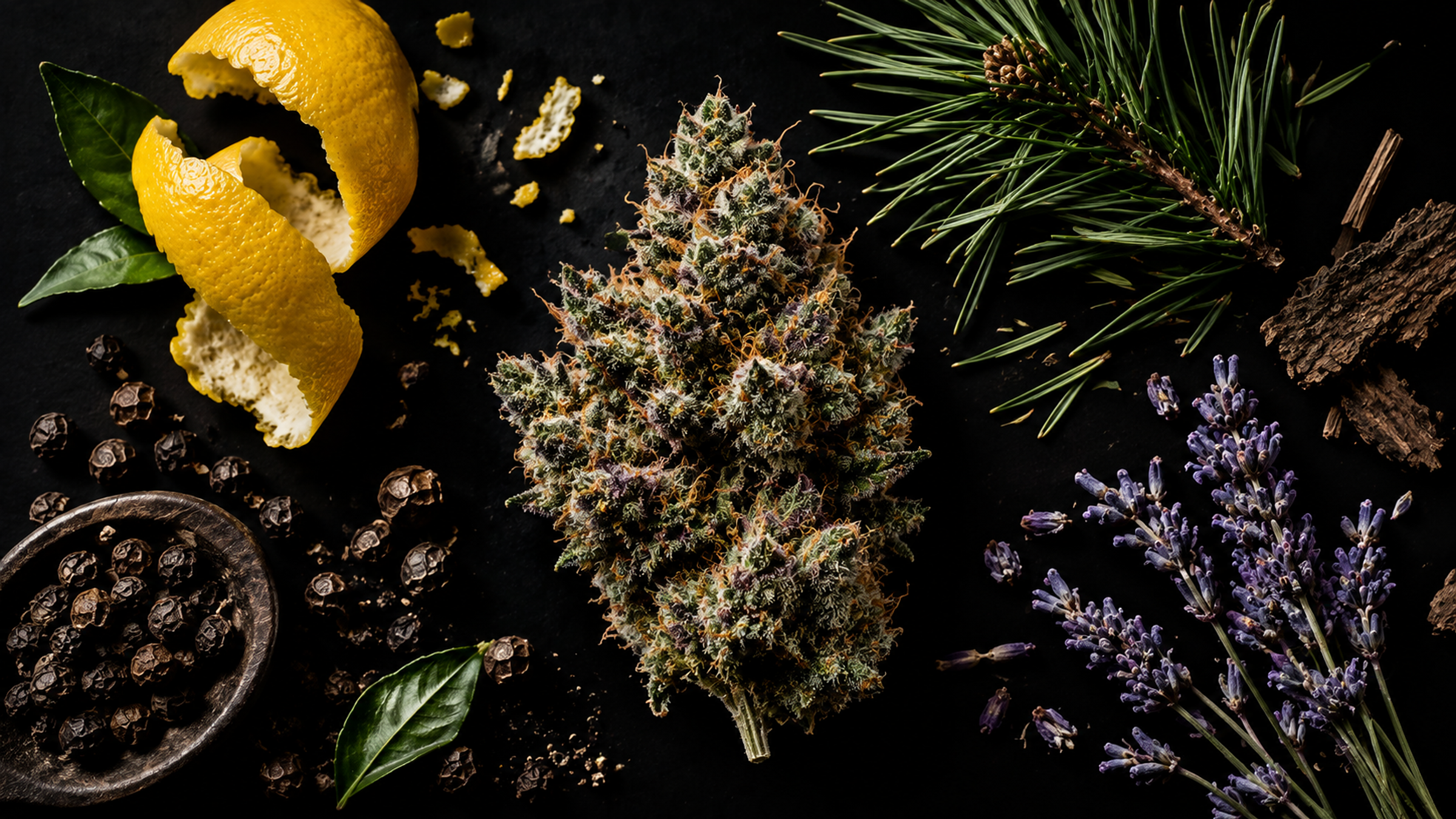
Limonene is associated with citrus aromas.
Pinene is found throughout the plant world and is associated with pine-like aromas.
Linalool contributes floral notes and is famously present in lavender.
Beta-caryophyllene contributes spicy, peppery characteristics and occurs in plants including black pepper.
Cannabis can produce these compounds in different combinations and concentrations, creating aromatic profiles that can vary dramatically from cultivar to cultivar.
And terpenes are only part of the chemistry responsible for what your nose detects.
Cannabis aroma is more complicated than a handful of terpene names printed on a package.
That complexity is exactly what makes smelling flower useful.
The Nose Doesn't Tell You Everything
Let's be clear.
A strong aroma does not automatically mean excellent cannabis.
And smelling cannabis cannot tell you its potency with scientific precision.
Your nose isn't a laboratory.
But aroma can provide clues about something consumers often overlook:
condition.
Fresh, properly handled flower should generally still possess aromatic character.
Cannabis that has been poorly dried, badly stored, exposed to excessive heat or oxygen, or left sitting for too long can lose volatile aromatic compounds over time.
That beautiful cultivar may have started with an incredible profile.
By the time it reaches you, some of it may be gone.
That means the question isn't simply:
What strain is this?
It is also:
What happened to this flower between harvest and me?
Cultivation Matters
Genetics establish potential.
Cultivation determines how much of that potential gets expressed.
The same genetics grown by two different cultivators can produce noticeably different results.
Environment matters.
Plant health matters.
Harvest timing matters.
Drying matters.
Curing matters.
Storage matters.
The person growing the plant matters.
That is why buying cannabis solely by strain name can be misleading.
Seeing a familiar cultivar on a menu doesn't guarantee you're getting the same experience you had the last time you encountered that name.
A name tells you part of the story.
It doesn't tell you how well that particular plant was grown.
Then Comes the Cure
Harvesting cannabis isn't the end of producing quality flower.
After harvest, flower has to be dried and prepared for storage and consumption.
This stage can dramatically affect the final product.
Dry too aggressively and the flower can lose aromatic character and become brittle.
Handle or store it poorly and quality can continue to deteriorate.
Good post-harvest handling preserves what the cultivator spent months producing.
Think about it this way:
Growing exceptional flower and mishandling it after harvest is like preparing an incredible meal and leaving it uncovered on the counter.
The ingredients may have been excellent.
The execution may have been excellent.
But condition still matters when it reaches the customer.
So Where Does THC Fit?
THC absolutely matters.
It is one of the principal intoxicating cannabinoids in cannabis, and potency is legitimate information for consumers to consider.
The problem begins when THC becomes a substitute for every other measure of quality.
Consider two hypothetical jars.
Jar A
30% THC.
Weak aroma.
Dry flower.
Months of shelf time.
Little flavor.
Jar B
23% THC.
Strong, distinctive aroma.
Fresh flower.
Well-preserved structure.
Expressive flavor.
Which one is better?
The lab number alone cannot answer that question.
And that's the point.
Potency is a measurement. Quality is an evaluation.
Those are not the same thing.
The Percentage Race
The cannabis market has created a strange incentive.
If consumers consistently shop by THC percentage, retailers have an incentive to prioritize high-THC products.
Brands have an incentive to emphasize potency.
Cultivators have an incentive to produce for the metric consumers are requesting.
Eventually, one laboratory number can begin shaping an entire marketplace.
But cannabis is a plant with considerably more complexity than a single percentage can communicate.
Imagine judging coffee exclusively by caffeine content.
Or wine entirely by alcohol percentage.
You would miss much of what makes either product interesting.
Cannabis deserves the same curiosity.
Look at the Flower
Your eyes provide another piece of the puzzle.
Look at the structure.
Look at the trichomes.
Look at the trim.
Look at whether the flower appears excessively dry or compressed.
Look at how it has been handled.
Color can be beautiful, but purple doesn't automatically mean premium.
Large buds don't automatically mean premium.
An extraordinary layer of visible trichomes is interesting, but appearance still doesn't tell the entire story.
Every signal gives you another piece of information.
None should become the whole evaluation.
Build a Better Vocabulary
Part of becoming a more informed cannabis consumer is learning how to describe what you're experiencing.
Instead of:
"It's strong."
Try:
What did it smell like?
What flavors stood out?
How fresh did the flower seem?
How was the moisture?
What was the texture?
What genetics produced it?
Who cultivated it?
How was it grown?
When was it packaged?
Did the experience match what the aroma suggested?
The more questions we ask, the less useful a single THC percentage becomes as shorthand for quality.
And the more interesting cannabis becomes.
Follow Your Nose, Then Ask Questions
Your nose can't certify great cannabis.
Neither can your eyes.
Neither can a strain name.
Neither can a price.
And neither can THC percentage.
But together, genetics, aroma, appearance, cultivation, freshness, cure, storage and chemistry begin to tell a much richer story.
That's the kind of story we're interested in.
Because if we're going to call something Za, we should probably understand why.
So the next time you're looking at two jars and one number seems to make the decision obvious, don't stop there.
Look closer.
Smell deeper.
Ask who grew it.
Ask when it was packaged.
Ask about the genetics.
Then look at the number.
The label gives you data.
The flower gives you context.
PUT IT INTO PRACTICE / HOUSE OF ZA
THC is one data point. Aroma, genetics, cultivation, freshness and cure provide additional context. Explore New York cannabis and the people producing it through House of Za's Buffalo menu.
EXPLORE HOUSE OF ZAHouse of Za is a founding retail collaborator of The Za Report. The Za Report is independently owned and operated. Commercial relationships do not determine editorial coverage or opinions.